Find the right tool to measure how much light your plants receive. This guide compares five highly relevant plant light intensity meters, highlighting who should buy each one and why. Use this to pick a meter that fits your growing space, budget, and accuracy needs. The top picks target indoor gardening, photography lighting work, and classroom or lab use. The table below summarizes key details to help quick comparisons.
| Product | Brand | Best For | Range | Notes |
|---|---|---|---|---|
| Light Meter Digital Illuminance Meter | URCERI | Home growers and hobbyists | 0–200,000 Lux | High accuracy; temp readout |
| Digital Illuminance Light Meter Tester 200,000Lux | Soonkoda | Educational and general use | 0–200,000 Lux | Broad utility; unit switch |
| TopTes TS-710 Light Meter | TOPTES | Photographers and growers needing precise angles | 0.1–200,000 Lux | 180° rotating sensor |
| Dr.meter LX1330B | Dr.meter | Precision readings for labs and studios | 0–200,000 Lux | PEAK data capture |
| UNI-T UT383 Light Meter | UNI-T | Film and photography workers | 0–199,900 Lux | Backlit display; auto shutdown |
Light Meter Digital Illuminance Meter Handheld Ambient Temperature Measurer
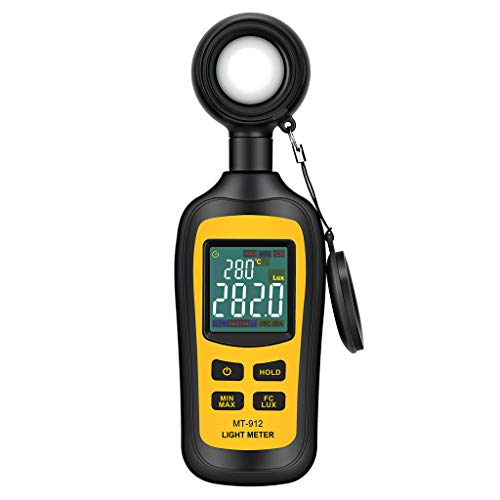
Product: URCERI Light Meter. Range up to 200,000 Lux with ambient temperature. Features a 4-digit color LCD, MIN/Max readings, data hold, auto power off, and low battery indicator. Best for: home growers and hobbyists who want a compact meter with temperature readout and clear data retention. Limitation: accuracy varies slightly at very low light levels, so use the MIN/Max to verify consistency.
Digital Illuminance Light Meter Tester 200,000Lux Meter

Product: Soonkoda S8608. Wide measuring range up to 200,000 Lux with automatic range conversion. Ideal for schools, hospitals, factories, and homes needing a straightforward lux/FC switch. Best for: educators and general users who want a simple, large-display meter for multiple environments. Limitation: lacks some advanced data logging features found in pricier models.
TopTes TS-710 Light Meter

Product: TopTes TS-710. 180° rotating probe, fast sampling every 0.5 seconds, and a backlit 2.25″ display. Range 0.1–200,000 Lux and 0.1–20,000 FC. Best for: growers and photographers who need flexible measurement angles and quick updates. Limitation: rotating sensor may require precise positioning in tight spaces.
Dr.meter LX1330B Digital Illuminance Light Meter

Product: Dr.meter LX1330B. Fast readings at up to 2 updates per second. Toggle between FC and LUX, with a peak data recording feature. Best for: labs or studios needing unit flexibility and peak measurement. Limitation: basic design and fewer advanced features than multi-sensor meters.
Mcbazel Digital Illuminance Light Meter

Product: Mcbazel Digital Illuminance Light Meter. Wide range up to 200,000 Lux with high-accuracy sensors and fast response up to 2 reads per second. Best for: photographers and indoor growers who need clear Lux/FC switching and a backlit LCD. Limitation: some users report tighter tolerances at very high lux values; verify with a second reading if precise calibration matters.
UNI-T UT383 Light Meter

Product: UNI-T UT383. Measures Lux and FC with a compact form and a large backlit LCD. Range up to 199,900 Lux. Best for: film and photography workflows requiring a compact, portable meter with reasonable accuracy and auto shutdown. Limitation: slightly lower max range than some peers; suitability depends on your expected light levels.
Buying Guide
What should you consider when choosing a plant light intensity meter?
- Range and accuracy: For indoor gardening, a meter that covers 0–200,000 Lux with ±3–5% rdg is typically adequate. If you work with photography or labs, prefer a model with peak data capture and FC/Lux conversion.
- Display and readability: Backlit LCDs and rotating sensors help in dim rooms or when measuring from difficult angles. Look for models with clear Min/Max data and data hold features to track changing light.
- Ease of use: Auto power-off saves battery, but quick-read times (0.5–2 seconds) matter for dynamic lighting scenarios such as filming or quick plant checks.
- Units and conversions: Choose a meter that can switch between Lux and FC, enabling seamless use across plant science, photography, and architectural applications.
- Durability and form factor: Handheld meters with a stable probe are preferable for bench work. If you have a humid environment, check for protective casing or moisture resistance.
Which features matter most for plant care?
- Consistency: Look for MIN/MAX readings to assess light stability over time.
- Angle flexibility: A rotating sensor helps measure light reaching leaves from different angles, important for tall or multi-level setups.
- Real-time data: Fast sampling ensures you can optimize lighting in response to plant response or lighting changes.
Choosing by use case
- Home growers and hobbyists: URCERI or Soonkoda models offer robust ranges and clear displays at a good price point.
- Professional photography or film: TopTes TS-710 or UNI-T UT383 provide fast, reliable readings and practical features for lighting setups.
- Education and labs: Dr.meter LX1330B and Mcbazel balance accuracy with straightforward operation and data capture.
Quick comparison by scenario
- Indoor grow room: Choose a meter with 0.1 Lux resolution and a rotating probe for flexible angles (TopTes TS-710).
- Photography studio: A backlit display and fast sampling help manage constant lighting shifts (UNI-T UT383).
- Classroom or workshop: A large display and simple unit switching support teaching environments (Soonkoda).
- Budget-friendly setup: URCERI offers essential features plus temperature readout.
FAQ
What is the practical unit for plant growth measurements?
Lux (illuminance) is commonly used to gauge light intensity impacting photosynthesis. Some meters switch to foot-candles (FC) for audiences who prefer that unit.
Do I need a rotating sensor?
If your plants are arranged in multi-directional layouts, a rotating sensor helps measure light from different angles more accurately.
Should I buy a meter with peak data recording?
Peak data is useful for capturing brief bright pulses from LEDs or sunlight through windows, aiding precise adjustments.
Is a backlit display important?
Yes for reading in low-light areas, filming studios, or early morning/late-evening checks without extra lighting.
Can I use these meters for photography lighting?
Absolutely. Many models provide Lux and FC readings, which photographers use to balance lighting for scenes and subjects.
Do these meters require calibration?
Most consumer meters rely on factory calibration and offer basic accuracy ranges. For critical horticultural or research work, periodic validation with a reference light source is recommended.