Finding the right air intake and filtration setup for a grow tent is essential for clean airflow, odor control, and stable environmental conditions. This guide highlights five reliable options that balance airflow, filtration, and energy use for American growers. Each product targets a specific need—quiet operation, odor control, or easy installation—so you can compare and choose what fits your setup. The buyer profiles below indicate who benefits most from each solution, whether you’re a hobbyist, a small-scale indoor gardener, or a room-wide grow operation. A quick summary table follows to help you compare at a glance.
| Product | Best For | Key Benefit |
|---|---|---|
| AC Infinity Grow Tent Duct Vent (2 Pack) | Small setups needing reliable vents | Light-blocking twist-on vents with built-in adapter |
| MELONFARM Air Filtration Kit (4″ Inline + Carbon Filter) | Odor control with solid airflow | High-quality carbon filter and strong inline fan |
| Hon&Guan 4″ 212 CFM Kit | Quiet performance in larger tents | EC motor, low noise, strong airflow |
| VIVOSUN 4″ Carbon Filter with Inline Duct | Effective odor removal | Premium Australian virgin charcoal, high absorption |
| AC Infinity CLOUDLINE Lite Kit | All-in-one cooling and odor control | Integrated fan, filter, and controller |
AC Infinity Grow Tent Duct Vent, 2 Pack

Best for: Small grow tents or starter setups that need simple, effective ventilation without complicated wiring. This 2-pack provides convenient, light-blocking twist-on vents with a built-in adapter, designed to keep pests and dust out while preserving airflow. Use when you want quick, modular airflow control at a lower setup effort.
Why selected: The combination of insect and dust blocking with minimal airflow restriction makes these vents a practical upgrade for tent ports. They are easier to install than full ducting runs and fit standard 6-inch duct ports.
Limitation: They rely on compatible ducting and may require additional filtration to address strong odors in larger rooms.
MELONFARM Air Filtration Kit
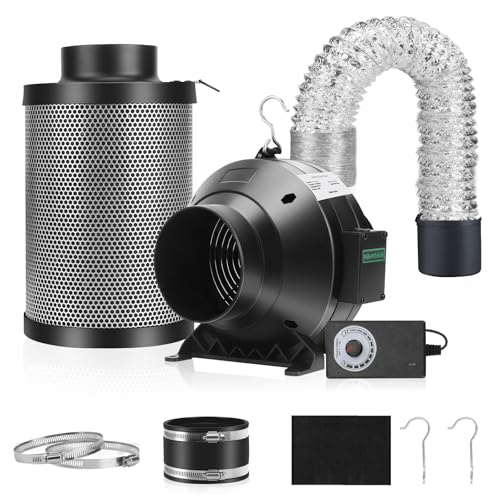
Best for: Grow tents that require strong odor control with reliable airflow performance. This kit pairs a 4″ inline duct fan up to 190 CFM with a 12″ carbon filter and 8 ft of ducting, plus a rubber coupler for easy installation.
Why selected: Premium activated carbon and a high-capacity fan help maintain fresh air and minimize smells, making it suitable for occupied spaces or odor-sensitive environments.
Limitation: Large odor loads may need additional filtration stages or pre-filters for extended life in high-humidity environments.
Hon&Guan 4 Inch 212 CFM Kit

Best for: Grow rooms requiring strong airflow with low noise and energy efficiency. This kit uses an EC motor and mixed-flow design to push up to 212 CFM with relatively quiet operation.
Why selected: The EC motor cools efficiently, saving energy, while maintaining robust airflow for medium-to-large tents. The aerodynamic design reduces resistance and boosts overall efficiency.
Limitation: EC motors can be pricier upfront, and the system may require careful wiring for dimming or speed control in smaller setups.
VIVOSUN 4 Inch Carbon Filter with Inline Duct

Best for: Indoor grows targeting strong odor removal with a durable, high-capacity filter. The filter uses premium charcoal and a long canister for extended filtration area.
Why selected: High absorption rate and a thick charcoal bed translate to effective odor control, which is crucial in spaces where smells can be a concern for neighbors or shared rooms.
Limitation: Replacement carbon filters over time require monitoring; performance drops as the bed becomes saturated.
AC Infinity CLOUDLINE Lite Kit

Best for: All-in-one solutions that want a compact, integrated airflow and filtration setup. Ideal for controlled environments where noise and space are concerns.
Why selected: The kit combines a CLOUDLINE inline fan with a carbon filter and a controller for easy speed management, delivering silent, efficient performance and odor control in one package.
Limitation: All-in-one units can be less customizable than separate components if you later need to expand airflow or add advanced control features.
Buying Guide
What should you consider when choosing an air intake and filtration setup for a grow tent?
- Size and airflow needs: Match CFM ratings to your tent size and heat load. Larger tents may require higher CFM to move air effectively.
- Filtration goals: Odor control requires a carbon filter with adequate surface area. For heavy odors, look for thicker beds and higher IAV ratings.
- Noise tolerance: EC motors and inline fans with noise-reducing designs suit living spaces better than high-velocity, loud units.
- Ease of installation: All-in-one kits offer simpler setup; modular components provide customization but may need more wiring and planning.
- Durability and seals: Look for sturdy flanges, reliable gaskets, and secure connections to prevent leaks and maintain filtration efficiency.
- Maintenance: Pre-filters and carbon replacement schedules affect ongoing costs and performance. Consider how easy it is to service.
- Expansion potential: If you anticipate growing your tent footprint, choose components that scale—larger canisters, extra ducting, and additional controllers.
FAQ
- What is the difference between an inline fan and a duct vent?
- How often should carbon filters be replaced?
- Is a single kit enough for a large tent?
- Can I combine different brands for better performance?
- Which setup is best for odor control in a shared space?
Inline fans move air through ducting and filters; duct vents are simpler outlets or ports that help control air flow without full duct routing.
Replacement timing depends on odor load and environment; signs include reduced odor control and visible saturation in the carbon bed.
It depends on tent size and heat load. Large tents may require multiple filters or higher-CFM fans to maintain air exchange.
Yes, but ensure compatibility in duct size (typically 4″ or 6″), mounting options, and electrical requirements.
All-in-one kits with high-absorption carbon filters and robust fans generally provide the strongest odor control with easier management.