Answering the search for a reliable, low-pressure soaker hose, these options deliver water directly to roots without high pressure or waste. They’re ideal for small to medium gardens, beds, and container plantings where steady moisture matters more than force. The best picks below are suited to buyers who want simple installation, good durability, and water-saving performance at modest water pressures. Each product is rated for low to moderate PSI, with built-in features to prevent over-watering and tangling.
| Product | Best For | PSI Range | Notes |
|---|---|---|---|
| RTS Home Accents 25-Foot Soaker Hose | Compact beds and pots | Low, built-in regulator | Excellent for tight spaces |
| RTS Home Accents 50-Foot Soaker Hose | Sloped beds and longer runs | Low, built-in regulator | Flexible, discreet in mulch |
| MIXC 2026 Thickened Flat Soaker Hose 100Ft | Longer, even coverage | Low-to-moderate with regulator | Thicker wall and copper joints for durability |
| Yeahjiae 25FT Flat Soaker Hose | Seedlings and fragile plants | 20–40 PSI (up to 60 PSI with regulator) | Eco-friendly water saving |
| DEWENWILS Soaker Hose 75FT | Medium to large garden beds | 30–40 PSI with regulator | Brass connectors, leak-proof |
RTS Home Accents 25-Foot Soaker Hose

Built-in water restrictor helps maintain low, steady pressure, reducing over-saturation. The tiny porous design delivers water directly to root zones for deep hydration with minimal evaporation. Best for compact plantings where space and discretion matter. Use under mulch or soil to keep irrigation hidden and efficient.
Best for: Small beds, potted plants, or tight garden corners where you want a quiet, low-flow soak. Choose this if you value a lightweight, flexible hose that stays unobtrusive in the landscape.
Caution: Performance depends on consistent low pressure; very high mainline pressure may require an external regulator to prevent over-watering.
RTS Home Accents 50-Foot Soaker Hose

The longer version extends deep root irrigation along garden beds, with a built-in regulator to sustain low pressure across the length. Its porous design minimizes water loss and supports nourished soil moisture without surface runoff. Better for mid-sized plots where uniform hydration is essential.
Best for: Regular-sized flower beds or vegetable rows where consistent moisture along a longer distance matters.
Caution: Ensure proper drainage around the hose to avoid pooling in heavy soils during peak watering times.
MIXC 2026 Thickened Flat Soaker Hose 100Ft

Thickened walls reduce leaks, while copper joints and aluminum seals prevent joint leaks under higher pressure. The long 360° swivel handle helps prevent tangling during placement. This hose is designed for durability and long runs, making it a strong choice for larger irrigation layouts.
Best for: Users who need a robust, long-run solution with strong joints and easy handling in complex layouts.
Caution: Heavier hose may be less convenient for very small spaces or portable setups.
Yeahjiae 25FT Flat Soaker Hose

Designed for 20–40 PSI and compatible up to 60 PSI with a regulator, this hose offers consistent, gentle soaking ideal for seedlings and delicate plants. It can be linked with other hoses for broader coverage and can operate above ground or buried under mulch for a hidden irrigation setup. It emphasizes eco-friendly water use by delivering moisture directly to roots.
Best for: Seedlings, new plantings, and garden beds where minimal disruption and water efficiency are priorities.
Caution: Not ideal for high-pressure spray zones; ensure a regulator is used to avoid overpowering the hose.
DEWENWILS Soaker Hose 75FT
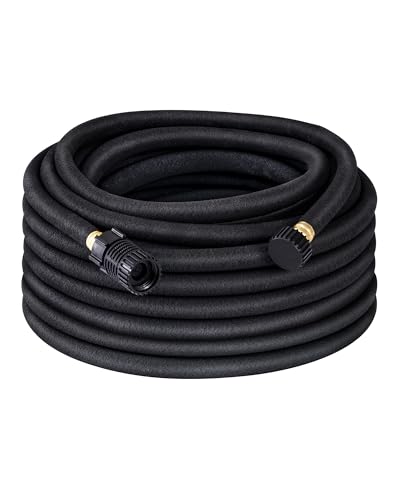
Constructed with a leakproof design and brass connectors to reduce water loss, this hose includes a built-in regulator to keep the system within a low-pressure range. Its durable, weather-resistant materials support reliability for beds, borders, and shrub lines. It aims to deliver efficient hydration with minimized evaporation.
Best for: Medium to larger garden areas where a dependable, low-pressure drip approach is needed alongside sturdier connectors.
Caution: The hose is heavy; account for handling and storage in tight spaces or windy days to prevent kinking.
Buying Guide: How to Choose a Low-Pressure Soaker Hose
- Pressure compatibility: Look for built-in regulators that hold a stable pressure in the 20–60 PSI range, depending on your water source and garden layout.
- Wall thickness and material: Thicker walls reduce leaks and bursts; flat hose designs save space and reduce kinking in tight beds.
- Joints and connectors: Copper or brass connectors with secure seals help prevent leaks at connections and adapt to various faucet sizes.
- Length and layout: Choose a length that matches bed dimensions or perennial borders. Consider expandable or linkable models for future expansion.
- Flexibility and placement: Flat or lightweight designs are easier to place under mulch or soil, while round hoses can be more forgiving on curved paths.
- Water savings and irrigation goals: If you want root-zone hydration with minimal evaporation, prioritize hoses advertised as delivering slow, direct-to-root moisture.
- Maintenance: Look for hoses that resist sun damage and cracking, especially in hot climates. Regular checks prevent hidden leaks from wasting water.
Frequently Asked Questions
- What PSI should a low-pressure soaker hose use? Most effective low-pressure hoses operate around 20–40 PSI, with many models tolerating up to 60 PSI when regulator-equipped.
- Can I connect multiple soaker hoses for large areas? Yes, many flat or linkable hoses are designed to be connected end-to-end for broader coverage.
- Are flat hoses better than round hoses for drainage? Flat hoses tend to lie flatter and resist crushing under mulch, while round hoses can be more flexible in tight spaces.
- Do these hoses require a timer? Timers aren’t required, but they help automate irrigation and maintain consistent moisture for plant beds.
- Will low-pressure hoses water deeply enough? Yes, when placed near root zones and run long enough, these hoses deliver sustained moisture to roots with reduced evaporation.
- How long should I run a low-pressure soaker hose? Start with 15–30 minutes and adjust based on soil type, plant needs, and weather conditions.