Answering the common question for dog owners: which product best helps fence off part of a yard to keep dogs out of specific areas? This guide compares five well-suited options, from electric containment systems to physical barrier fences, so you can choose the right approach for your yard size, climate, and dog temperament. The selections focus on reliability, ease of installation, and practical use for residential spaces. Each product is best for different scenarios, such as small-to-medium yards, large outdoor spaces, or pet training needs.
Overview table of selected products:
- VERSMELO GPS Wireless Dog Fence — best for large, open areas and long-term boundary control
- Eibikdi 25 Pack Garden Animal Barrier Fence — best for creating flexible, modular barriers along edges
- NANYEZH 25 Panels Animal Barrier Fence — best for long garden edges and multiple fence configurations
- PetSafe Stubborn Dog In-Ground Fence — best for custom-shaped, underground containment
- iMounTEK Electric Dog Fence System — best for adjustable containment with wired setup
VERSMELO GPS Wireless Dog Fence

The VERSMELO system uses a U.S.-made GPS chip with AI to provide real-time boundary awareness. This setup is best for large yards or farms where a traditional boundary is impractical. It supports a circular boundary from 33 to 1999 yards, offering broad outdoor coverage and minimizing false alarms in open spaces. The system also features a gentle correction method using sound, vibration, or up to six levels of static stimulation. It’s most suitable for owners who need flexible, expansive boundaries and are comfortable with an outdoor-heavy setup.
Who it’s best for: large properties, rural or semi-rural homes, and dog owners who want a scalable, perimeter-style fence without extensive digging. The GPS approach reduces the need for buried wiring. Choose this if you have an open landscape and want automatic boundary resumption when the dog returns to the open area.
Limitation: Not ideal for dense woods, very small yards, or indoor-only setups where GPS accuracy may be challenged by obstructions or signal interference.
25 Pack Garden Animal Barrier Fence (Eibikdi)
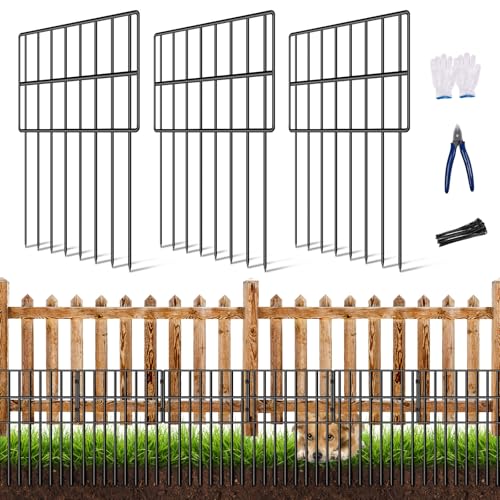
This 25-panel barrier fence offers low-profile, flexible protection for garden borders. Each panel measures 17 inches high and 13 inches long, with 1.5-inch gap spacing designed to block dogs from digging and to deter small animals from entering. Because the panels can be connected to form different shapes, they’re well-suited for irregular yard layouts, edging flower beds, or creating a temporary boundary along a patio. The rustproof metal construction adds durability in varied weather.
Who it’s best for: homeowners who want a modular, adaptable barrier that can wrap around garden edges or patios. It’s a practical choice for temporary or seasonal use and for creating simple perimeters without permanent installation. Avoid this if you need a continuous, seamless barrier along a long fence line, as gaps may exist where panels connect.
Limitation: Each panel is lightweight, and very large or high-traffic dog routes may require more robust, permanent fencing for long-term containment.
Animal Barrier Fence, 10 Pcs (Blingluck)

This package includes 10 metal fences with a 1.26-inch gap, designed to reduce escape opportunities for dogs and keep small animals from entering your yard. Each fence is rust-resistant with welded construction for durability. The system is easy to install with pre-determined drop points at the top for hammering and includes snaps to attach sections securely. It’s a strong option for side-yard defense or perimeter reinforcement along garden borders.
Who it’s best for: owners who want a sturdy metal barrier with improved dig defense and easy assembly. Best for expanding existing fences or creating a flexible boundary along multiple problem spots. Avoid this if you only need temporary decor-level barriers or if you require a fully enclosed, continuous fence line.
25 Panels Animal Barrier Fence (NANYEZH)

The NANYEZH barrier system provides 25 panels totaling 27 feet in length, designed to fill gaps and extend the protection range of existing fences. With 1.25-inch gap spacing, it aims to deter dogs from digging under fences and prevent small animals from entering the yard. The rustproof metal construction promises long-term use and resilience in outdoor environments. It’s an adaptable solution for creating extended boundaries along garden edges or pathways.
Who it’s best for: homeowners who need longer fence runs and flexible configurations to cover perimeter lines. Choose this if you want a longer, modular barrier that can be shaped around odd corners. Limitation: installation may require planning to connect multiple sections smoothly without gaps.
PetSafe Stubborn Dog In-Ground Fence

The Stubborn Dog In-Ground Fence offers a DIY, 2-person installation that creates a custom boundary for areas up to 1/3 acre. It uses a waterproof collar with tone, vibration, and four levels of static correction to shape behavior as your dog approaches the boundary. The system is designed to accommodate dogs older than six months and at least eight pounds, with adjustable neck sizing for a secure fit. It’s a solid pick for homeowners who prefer a buried wire solution that can be tailored to irregular yard shapes.
Who it’s best for: dog owners wanting a precise, custom-shaped underground fence and adjustable training levels for varying dog temperaments. Better for moderate yard sizes and for those who don’t want visible barriers. Caution: underground wiring requires careful installation to avoid interference from utilities or future landscaping changes.
iMounTEK Electric Dog Fence System

This electric fence system uses a buried boundary wire with a wall-mounted transmitter to train dogs to stay within a designated space. It provides automatic beeps and shocks as the dog approaches the boundary and offers adjustable range settings. A key feature is the ability to tailor the boundary width for different yard zones and dog sizes. It’s suitable for households that prefer wired containment with automatic correction and remote boundary flexibility.
Who it’s best for: owners who want a wired containment approach with adjustable boundaries and a hands-on training method. Choose this if you’re comfortable with wiring and want a robust, expandable system for multiple yard zones. Caution: the system relies on proper wire installation and maintenance; improper setup can lead to false corrections or boundary gaps.
Buying Guide
What Type Of Fence Makes Sense?
- Permanent physical fences: Best for long-term, high-traffic dogs and full containment along property lines. Choose if you want a visible, durable barrier with minimal ongoing maintenance.
- Modular barriers: Ideal for irregular yards, temporary setups, or seasonal use. Panels can be moved, reconfigured, or removed as needed.
- Underground or wireless systems: Great for large open spaces or when ground installation is impractical. Ensure the yard has a stable signal and adequate coverage for your dog’s behavior.
Consider Yard Size And Dog Temperament
- Large yards: GPS or wireless perimeter systems reduce the need for long buried wires and offer scalable coverage.
- Small-to-medium yards: Modular panel fences and 1.25–1.5 inch gap barriers can be cost-effective and easier to install.
- High-energy or escape-prone dogs: Look for reinforced materials, smaller gap sizes, or a combination of barrier and training system.
Installation And Maintenance Considerations
- Portable vs. permanent: Portable options suit renters or seasonal use; permanent options suit homeowners seeking long-term solutions.
- Weather resistance: Rustproof or weatherproof materials extend life in varied climates.
- Future landscaping: Plan around potential yard changes to avoid misalignment or gaps after renovations.
Safety And Training Implications
- Training levels: Start with the lowest correction level and observe your dog’s response to ensure humane training.
- Boundary visibility: Ensure signs or indicators are visible to pedestrians in shared or sidewalk-facing yards.
- Backing up expectations: A barrier is most effective when used alongside training and positive reinforcement, not as a sole deterrent.
FAQ
- What’s the easiest option to install for a renter?
– Portable barriers or modular fence panels are typically easiest to install without permanent changes. - Are GPS fences accurate in all neighborhoods?
– GPS accuracy can vary with terrain, weather, and signal interference; open spaces tend to work best. - Can I use multiple systems together?
– In some cases, combining physical barriers with training-based fences can improve containment, but ensure proper supervision and safety checks. - What maintenance do these fences require?
– Regular inspection of panels, signs, and wiring (if applicable) helps prevent gaps and wear that could let a dog escape. - Is a boundary fence considered humane?
– When used with proper training and humane correction levels, containment fences can promote safe outdoor play without constant supervision. - Can large dogs be contained indoors?
– Large or strong dogs may require reinforced barriers or higher-grade containment systems designed for their size and strength.