Find reliable submersible pumps designed for continuous operation across ponds, fountains, basins, and hydroponic setups. This guide highlights five top options, explaining who each model suits best and why. Use this overview to compare flow, durability, and features for sustained use.
Summary of selected products:
- FREESEA Submersible Water Pump For Fountain: 700 GPH, 40W — best for small tanks and hydroponics.
- WORKPRO Submersible Water Pump, 1HP 4500 GPH — best for larger basins and pool drainage.
- PHLEX PRO Submersible Water Pump 5300GPH — best for dirty water and high flow needs.
- Acquaer 1/3 HP Submersible Water Pump — best for versatile household drainage tasks.
- TONGCHANT Adjustable Flow Pond Pump — best for customizable fountain and waterfall setups.
FREESEA Submersible Water Pump For Fountain

The FREESEA model offers a bottom inlet design with strong suction, capable of drawing water from as shallow as 0.5 mm. It includes a 360° omnidirectional filter to remove debris and a detachable water outlet for various piping sizes. This makes it suitable for fish tanks, ponds, aquariums, and hydroponic systems. The motor is described as whisper-quiet and corrosion-resistant, and it features a smart temperature protection chip that stops pumping if the water overheats, then restarts when safe. This pump is best for small-to-medium decorative setups and hydroponic applications that require quiet operation and reliable flow.
- Best for compact aquariums, small ponds, and hydroponics with quiet operation.
- Better for environments where low noise and easy maintenance matter.
- Caution: In some setups with very shallow water, ensure the intake remains submerged to prevent dry running.
WORKPRO Submersible Water Pump, 1HP 4500 GPH

The WORKPRO pump delivers up to 4500 GPH with a 31 ft lift, using a 1HP motor. It includes an automatic float switch and supports both automatic and manual modes. Suitable for transferring clean or dirty water, it can handle solids up to 1-1/5 inches, which helps prevent clogging and motor damage in mixed-water environments. This makes it ideal for draining pools, flooded basements, and large garden or pond projects. A caution is that power requirements are higher, so ensure a proper outlet and safe installation.
- Best for large drains, flood cleanup, and heavy-duty water transfer.
- Better for situations requiring automatic control with a float switch.
- Choose this if you need to move dirty water and tolerate higher energy use.
PHLEX PRO Submersible Water Pump 5300GPH

The PHLEX PRO pump provides a robust 5300 GPH flow, with a 26 ft lift and a 1/5″ solids tolerance for handling debris. It features a removable base for easy cleaning and improved lifespan, and it can automatically switch between clean and dirty water discharge. This makes it well-suited for pools, basements, and larger drainage tasks where solids management and maintenance access are important. A limitation is that higher flow can demand more power and generate more heat if not properly vented.
- Best for high-flow drainage of pools, basements, and large water features.
- Better for mixed-water environments where debris is present.
- Avoid if you need ultra-quiet operation and minimal heat generation in a small enclosure.
Acquaer 1/3 HP Submersible Water Pump
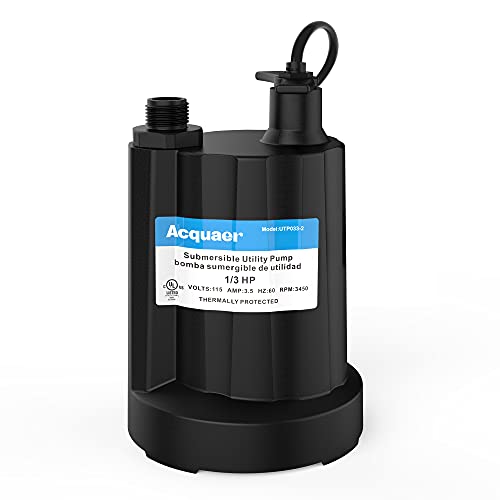
This 1/3 HP Acquaer pump delivers up to 2160 GPH with a 33.5 ft lift and includes a 10 ft cord. It uses thermoplastic materials for durability and corrosion resistance, with an ergonomic handle for portability. It suits basements, ponds, window wells, pool covers, and garden drainage, as well as irrigation and general water transfer tasks. A caution is that slightly lower flow compared to high-end industrial pumps means slower drainage in very large projects.
- Best for versatile, all-around drainage and water transfer needs in households.
- Better for portability and moderate power requirements.
- Avoid if you require very high-flow, industrial-scale drainage in one go.
TONGCHANT Adjustable Flow Pond Pump
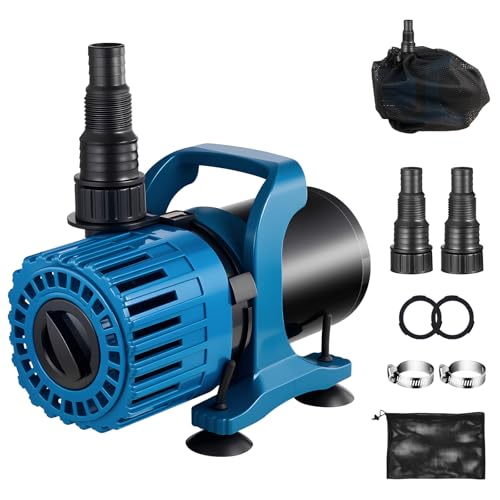
The TONGCHANT pump offers up to 1800 GPH with a 13 ft lift. Its standout feature is the adjustable flow control, allowing fine-tuning for fountains, koi ponds, waterfalls, or water gardens. The design supports both submerged and on-land placement, and the outlet direction can be rotated 180°, enabling precise water placement. It uses an epoxy-sealed, low-noise magnetic drive and features a thermal overload protection to safeguard the motor. This model is best for customizable outdoor water features and energy-efficient operation.
- Best for customizable fountain and waterfall setups.
- Better for outdoor ponds where precise flow and direction matter.
- Avoid if you need extremely high flow in a compact space.
Buying Guide: Key Considerations for Continuous-Use Submersible Pumps
Flow rate and lift height: Match the pump’s GPH and vertical lift to your project size to ensure efficient circulation without overworking the motor.
Water type: Choose a pump rated for clean water, dirty water, or dual-use depending on whether debris is expected in the system.
Automatic vs manual operation: A float switch or smart controller helps automate drainage or circulation, reducing maintenance needs in long-running setups.
Durability and material: Look for corrosion-resistant housings, ceramic shafts, and thermoplastic or metal components designed for prolonged submersion.
Noise and energy efficiency: For living spaces or classrooms, prefer quiet operation and energy-saving features such as thermal protection and efficient motors.
Maintenance access: Detachable bases, removable filters, and easy clean pathways simplify ongoing maintenance in continuous-use environments.
Installation flexibility: Pump placement (submerged vs on-land) and outlet rotation can influence where the unit fits and how water is directed.
Frequently Asked Questions
- What defines a pump as suitable for continuous use?
Look for built-in thermal protection, durable materials, and a design intended for long runtime without overheating. - Is a higher GPH always better for a pond?
Not necessarily. Match GPH to the pond volume to avoid excessive turbulence and unnecessary energy use. - Do I need a solid-state controller or a float switch?
Float switches offer automatic shutoff based on water level, reducing dry-running risk; controllers can provide more precise flow management. - Can submersible pumps handle dirty water?
Some models are designed for dirty water with debris tolerance; check solids handling specs to prevent clogs. - What maintenance steps extend pump life?
Regular cleaning of intakes, removing debris, and inspecting seals help maintain efficiency and prevent blockages.
Summary table of key product attributes was provided in the introduction to help you compare at a glance.