Discover white-light LED grow lights that maximize indoor plant growth while saving energy. This guide highlights five strong options well-suited for seed starting, leafy greens, herbs, and small fruiting plants. Each product section explains who it’s best for, its standout features, and a practical caveat. Use this guide to compare brightness, spectrum balance, efficiency, and ease of use.
| Product | Best For | Key Benefit |
|---|---|---|
| Briignite Full Spectrum LED Grow Light Bulb (3-Pack) | Budget-friendly beginners and small spaces | Low-watt, high efficiency with 5000K white plus red/blue spectrum |
| Barrina T5 80W 2ft LED Grow Lights | Lettuce, herbs, seedlings in compact setups | 2ft strips with strong PPFD and easy daisy-chain install |
| GooingTop 6000K Clip Grow Light | Desk plants and herb gardens needing flexible placement | Clip-on design, dimmable with timer |
| Barrina 4FT 252W T8 Grow Light Strips | Growing tents and shelves with higher light demand | Higher total output in a slim form factor |
| GYTF Halo 6000K Full Spectrum | Compact setups needing adjustable height | Adjustable height, timer, and dimming |
Briignite Full Spectrum LED Grow Light Bulb — 3 Pack

The Briignite A19 LED grow bulbs deliver a full spectrum in a compact, energy-efficient package. Best for indoor gardens with limited ceiling height or lamp fixtures, these 11W bulbs claim 100W-equivalent brightness with a 5000K white appearance and a red/blue spectrum for full growth stages. They are suited for tomatoes, cucumbers, peppers, leafy greens, and herbs. Caution: while energy-efficient, the actual PPFD in a given fixture may vary based on distance and reflector design.
Who it’s best for: Small-space growers, beginners, and anyone who wants an affordable, plug-and-play full-spectrum option. It’s particularly suitable for seed starting and compact containers that need reliable light without high electricity use.
Why selected: High efficiency and broad spectrum in a familiar A19 form factor make it a practical upgrade over basic household bulbs for basic indoor gardens. The 100W-equivalent claim provides a simple comparison for new growers.
Limitations to note: It uses standard E26 sockets; ensure your fixture can accommodate multiple bulbs without overheating. The product data focuses on brightness and spectrum rather than long-term durability, so plan for replacement over time if used intensively.
Barrina T5 Grow Lights, 2ft — 8-Pack

Barrina’s 2-foot T5 grow lights are designed to provide full-spectrum daylight replacement, with 5000K white light and high PPFD. This 8-pack option delivers 80W together (about 400 LEDs total) and claims strong plant absorption, suitable for seeds, seedlings, and vegetative growth. They’re easy to install with double-sided tape, clips, or cable ties, and can be linked in series for larger setups. A key caveat is that mounting should avoid dusty or rough surfaces, and non-magnetic components require careful setup.
Who it’s best for: Home growers expanding grow shelves or tents, especially if you want scalable lighting across many trays or shelves without heavy fixtures.
Why selected: Excellent energy efficiency and straightforward installation make this a practical choice for beginners and hobbyists who need reliable daylight-like lighting across multiple plant zones.
Caution/limitation: The 2ft length may require multiple units to achieve uniform coverage for larger beds. Ensure compatible hanging or mounting hardware for your space.
GooingTop Clip Grow Light — 6000K Full Spectrum
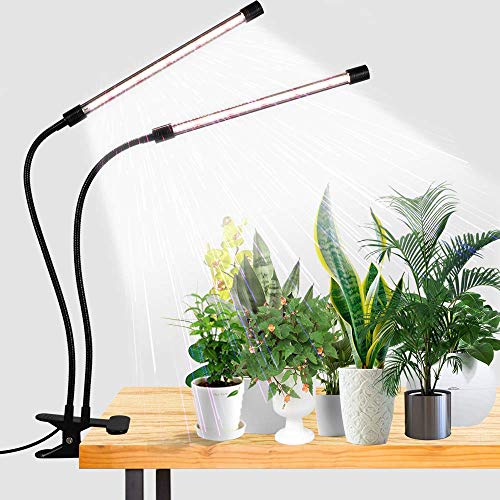
GooingTop offers a compact clip-on grow light with a tall focus on 6000K white light, augmented by red LEDs for a fuller spectrum. Its 10 red + 74 white LEDs provide a bright, daylight-like glow, suitable for desk gardens, succulents, or small potted plants. A 5-level dimming and adjustable timer (4/8/12 hours) allow precise control, while USB or AC power keeps setup simple. A potential limitation is that clip strength may vary with heavy pots, requiring careful placement to avoid tip-overs.
Who it’s best for: Individuals with limited space who want a flexible, adjustable light that can be aimed toward several small plants at once.
Why selected: The built-in timer and dimming provide practical automation for beginners and busy households, with an appealing 6000K balance for fast-growing greens.
Caution/limitation: Clip strength and stability depend on the mounting surface; use a sturdy clip or additional support for heavier setups.
Barrina T8 4FT Grow Light Strips

Barrina’s 4-foot T8 strips deliver 252W of full-spectrum light across multiple bars, designed to replace higher-wattage traditional grow lights. At 5000K, the white spectrum is comfortable for eyes and supportive for a wide range of indoor crops, including seedlings, vegetative growth, and flowering. The product emphasizes compatibility with Barrina cords and a second-generation safety design to prevent electrical misconnection. A practical note: ensure you have a clear, flat mounting surface and proper cable management for long runs.
Who it’s best for: Growers using larger shelves or tents who need higher total light output in a slim, modular format.
Why selected: High total output with broad spectrum in a linear fixture suits mid-sized indoor growing environments needing even coverage across many plants.
Caution/limitation: Requires compatible cords and careful wiring to avoid tangling or accidental disconnections in complex setups.
GYTF Halo Plant Grow Light — 6000K Full Spectrum

GYTF’s Halo lamp offers a circle of white 6000K LEDs with red and blue accents to deliver a balanced full spectrum. It is height-adjustable and dimmable with a timer (4/8/12/18 hours), making it flexible for plants from seedlings through flowering. The design emphasizes a standing unit that can be positioned near tall or short plants. A potential limitation is that the unit’s footprint may be larger than compact clip models, which matters for ultra-tight benches.
Who it’s best for: Enthusiasts who want a tall, adjustable light that can grow with their plants as they move from seedling to bloom.
Why selected: The extendable height and multiple timer options provide scalable control in a single device, reducing the need for multiple light sources.
Caution/limitation: Larger base may limit placement in very tight spaces; plan spatial layout before purchase.
Wiaxulay LED Plant Grow Light Strips — 3 Bars

Wiaxulay offers full-spectrum 6000K white grow light strips with 380–800nm coverage, arranged in three bars for flexible placement across shelves or desks. The system includes 6/12/16-hour timers and five brightness levels, enabling a responsive setup for seed starting or vegetative growth. The row design is ideal for wider planter setups but may require careful alignment to ensure even coverage across all plants.
Who it’s best for: Growers needing a modular strip system to fit around planters in a greenhouse corner or on a hydroponic bench.
Why selected: The combination of full-spectrum output and a memory timer supports automatic operation with modest energy use, suitable for ongoing indoor garden tasks.
Caution/limitation: Be mindful of the total length and brightness to avoid overloading any single outlet or creating hotspots on dense plant groups.
Buying Guide: White Light LED Grow Lights
What matters most when selecting white-light LEDs for indoor plants? Consider spectrum, intensity, efficiency, fixture type, and adjustability. White light should cover a broad spectrum similar to natural sunlight to support all growth stages. PPFD (photosynthetic photon flux density) matters for how much usable light plants receive at the canopy level. Efficiency, measured in lumens per watt or micromoles per joule, indicates energy savings over time. Fixture type—bulbs, strips, or panels—affects coverage pattern and expansion possibilities. Finally, look for dimming, timers, and adjustability to tailor light to plant needs and space constraints.
- Best for compact spaces: A19 bulbs or short T5 strips that fit tight shelves or lamps with minimal risk of heat buildup.
- Best for scalable setups: Linear strips (T8/T5) and bar arrays enabling multiple units and even coverage across larger benches.
- Best for automation: Lights with built-in timers and dimming, allowing precise schedules and intensity control.
Choosing between full-spectrum white lights versus targeted red/blue enhancements depends on your crop mix. For leafy greens and herbs, a broad 4000–6500K spectrum generally supports steady growth. For flowering or fruiting plants, adding a touch of red wavelengths can boost flowering and yields. Ensure you’re using lights at a proper distance to avoid heat stress while delivering enough PPFD for photosynthesis.
FAQ
What color temperature is best for most indoor plants?
Most leafy greens and herbs respond well to 4000–6500K. A cooler 5000K–6500K range supports vegetative growth, while balanced full-spectrum options work across growth stages.
Do LED grow lights save energy?
Yes. LEDs typically consume less power than traditional grow lights while delivering similar light output, reducing electricity usage over time.
How far should a grow light be from plants?
Distance depends on light intensity and fixture design. Start with 12–24 inches for most strip and bulb setups and adjust to avoid leaf burn or insufficient coverage.
Is a timer essential for indoor growing?
Timers help ensure consistent day/night cycles, reduce manual effort, and support plant health during seed starting and growth phases.
Can I mix different brands of lights?
Yes, but ensure spectra align and distances are appropriate. Mixing can broaden spectral coverage but testing for even canopy intensity is important.