Answer: A living wall planter kit is ideal for anyone wanting to create a vertical garden in compact areas, indoors or outdoors. This guide highlights five solid options that balance size, self-watering features, and ease of installation. The best fits vary by need: urban renters should consider compact, easy-to-mount systems; busy households benefit from self-watering designs; and outdoor setups can favor weather-resistant materials. Below is a quick comparison to help choose the right kit for your space and plants.
| Product | Best For | Key Benefit |
|---|---|---|
| SunVara Vertical Wall Planter 64 Pockets | Big vertical displays, outdoor walls | Many pockets for a diverse display |
| NEATOOM 36-Pocket Wall System | Self-watering convenience | Smart timer and rain sensor |
| YCBTREE 36-Pots Wall Planter | Balanced indoor/outdoor use | Self-watering with 36 pots |
| Ogrmar 36 Pockets Wall Garden | Budget-friendly large walls | Eco-friendly felt, flexible mounting |
| BOXSAND-12 Vertical Wall Planter | Small apartments or kitchens | Compact 12-plant frame, simple install |
SunVara 64-Pocket Vertical Wall Planter

Best for large, dramatic vertical displays on outdoor walls or sunny patios. The 64 pockets offer abundant space for a mix of herbs, vegetables, and flowering plants. Durable construction helps withstand outdoor weather, making it a solid choice for urban balconies or garden walls. Caution: installation requires secure mounting to support weight when fully planted.
Who it’s best for: outdoor-focused homeowners and urban dwellers who want a robust, space-saving garden wall with plenty of plant variety.
36 Pockets Living Wall Planter Indoor/Outdoor (CENCESON)

Better for versatile indoor or outdoor setups where self-watering helps reduce maintenance. This kit connects six groups of pockets and includes a compact footprint with a total spread around 39.3 by 39.3 inches. Best for homeowners who want a manageable, modular wall with simple replanting. Limitation: some users may find the assembly more involved due to multiple connected pockets.
Who it’s best for: busy households and apartment dwellers who value a self-watering system and modular growth.
NEATOOM Self Watering Planters with Timer and Rain Sensor
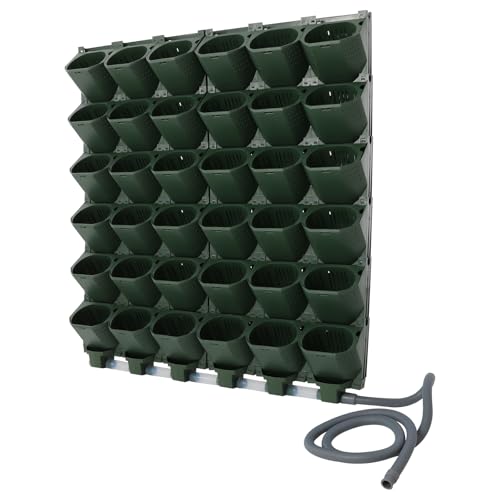
Best for households that want smart watering and hands-off maintenance. The kit includes a timer and a rain sensor to automatically pause irrigation on rainy days, conserving water. The 36-pocket framework and included irrigation components create a complete drip system suitable for balconies, kitchens, or sunlit interiors. Caution: relies on a steady water source and proper hose setup to function optimally.
Who it’s best for: travelers, busy families, or office environments needing automated irrigation and water savings.
YCBTREE Self-Watering 36-Pots Wall Planter

Best for flexible indoor/outdoor use with a strong self-watering feature. The reservoir-and-wicking design helps maintain consistent moisture, supporting herbs, flowers, and small vegetables. The 36 pots provide ample planting space while staying compact enough for smaller walls. Limitation: may require careful monitoring to avoid overwatering in very humid environments.
Who it’s best for: kitchen herb walls or compact patios where consistent watering is a priority.
BOXSAND-12 Vertical Wall Planter

Best for compact spaces like apartments or kitchens where a small, tidy green wall is desired. The 12-plant frame is easy to mount and provides a straightforward growing surface. Made from durable ABS, it’s weather-resistant for indoor or outdoor use. Caution: smaller capacity means fewer plant types at once, which may limit seasonal variety.
Who it’s best for: renters or first-time vertical gardeners needing simple installation and a compact footprint.
Buying Guide: How to Choose Your Living Wall Planter Kit
- Space and mounting: Measure available wall area and check mounting hardware. Consider whether you need a freestanding frame or a wall-fixed system.
- Watering system: Decide between self-watering reservoirs, timers, and rain sensors. Automatic systems save time but require setup and occasional maintenance.
- Plant compatibility: Choose a kit with appropriate pocket size and depth for herbs, leafy greens, or small vegetables. Larger pockets support bigger plants but may require more water.
- Material and durability: Look for weather-resistant materials for outdoor use and BPA-free plastics for indoor use. Consider weight when fully planted.
- Maintenance needs: Self-watering systems reduce daily care but need periodic checks of hoses, reservoirs, and soil.
- Expandability: If you plan to grow more plants later, consider modular designs with connectable sections or stackable panels.
- Installation effort: Some kits require tools and time to assemble; others are quick to mount with minimal hardware.
Common Questions
- What size should I choose for a small balcony? A compact 12-36 pocket system is usually sufficient for a decorative herb wall or a few flowering plants.
- Do these systems require frequent watering? Self-watering designs reduce daily watering needs, but all vertical planters still require monitoring during hot or dry periods.
- Can I use these indoors? Yes, most kits are suitable for indoor use, especially those with self-watering features and indoor-friendly materials.
- Are the panels easy to reconfigure? Many modular systems are designed to be rearranged or expanded, but check the connector method before purchase.
- Is installation difficult? Some kits are plug-and-play with simple mounting, while others need more assembly. Refer to product specifics for details.
- What plants grow best on a living wall? Herbs (basil, parsley, thyme), compact vegetables (lettuce, lettuce mixes), and flowering plants (petunias, marigolds) are popular choices for vertical walls.