Yes—an automatic drip system for your garden can save water, reduce maintenance, and keep plants evenly hydrated. This guide highlights five reliable options, explains who they’re best for, and shows you how to choose the right setup for your space, from containers to raised beds.
| Product | Main Focus | Best For | |
|---|---|---|---|
| Maotong 240FT Drip Irrigation Kit | High-capacity irrigation with 1/2″ main line | Large pots, greenhouses, multi-zone setups | Best for: expanding to two separate systems |
| MIXC 230FT Quick-Connect Kit | Quick-connect tubing with 1/2″ and 1/4″ lines | Garden beds, patios, greenhouses | Better for: fast setup and flexible layout |
| MIXC 100Ft Drip System | Universal 1/4″ components and adjustable nozzles | Smaller spaces, raised beds, containers | Choose this if: you need compact coverage |
| TJJFMM 230FT Kit | 1/2″ main line with quick-connects | Greenhouse and lawn edges | Best for: water savings and scalable design |
Below are five carefully chosen options, described in practical terms to help you compare features, setup, and suitability for different garden layouts. Each product section includes who it’s best for and a caveat to consider before buying.
Maotong 240FT Drip Irrigation Kit
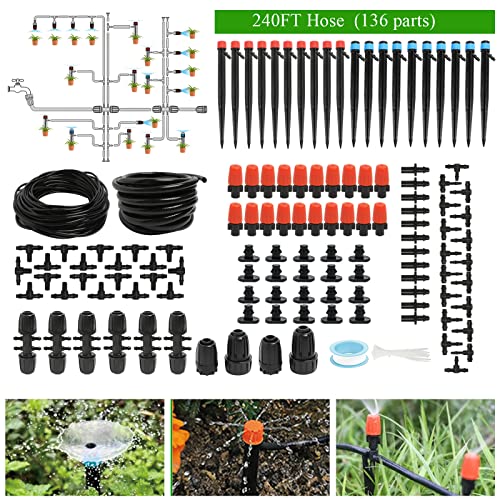
The Maotong kit centers on a robust 1/2″ main hose and 1/4″ distribution tubing, designed to cover up to 250 square feet when configured as a single long line, or two zones of about 120 square feet each. This makes it well suited for medium-to-large garden plots, greenhouse benches, or lawns needing reliable, uniform moisture. Best for: homeowners planning a two-zone system or expanding to two separate irrigation loops.
Key considerations: 136 included parts provide flexibility for custom layouts, and the upgraded 1/2″ main tubing supports higher water pressure. A potential limitation is that setup may require careful planning to split into two zones and align with water supply. The kit aims to reduce manual watering by delivering consistent moisture to roots.
MIXC 230FT Quick-Connect Kit

The MIXC kit emphasizes fast, tool-free assembly with quick-connect tubing and a combined 1/2″ main line with 1/4″ distribution tubing. It includes a broad assortment of emitters, mist nozzles, and tees, designed to support up to 32 emitters for comprehensive garden coverage. Best for: DIYers who want a flexible, plug-and-play system that’s quick to set up in a garden, greenhouse, or patio.
Who it’s best for: gardeners seeking a complete starter set with modern quick-connect technology and broad compatibility. Limitation: the system’s complexity can be daunting for very small spaces or first-time users who prefer very simple configurations.
MIXC 100Ft Drip System

This MIXC kit uses a universal 1/4″ sizing approach, designed to mitigate hose-size mismatches common in US setups. It features bendable emitter rods with copper nozzles for adjustable water patterns, enabling drip, spray, or sprinkler configurations. Best for: smaller to medium spaces where adjustable coverage is desirable and space is a factor.
Best for: users needing precise rod positioning and flexible nozzle patterns. Caution: limit to no more than eight rods per 50 feet of tubing to avoid pressure drop and uneven watering as area expands.
TJJFMM 230FT Drip Kit for Garden

The TJJFMM kit highlights an upgraded 1/2″ main line and a 4-way connector, enabling two drip irrigation systems in one setup. It emphasizes water savings by delivering moisture directly to roots, reducing waste and evaporation. Best for: gardeners seeking scalable design with clear water-saving benefits and straightforward installation.
Who it’s best for: growers with multiple planting zones, such as a greenhouse bench plus a lawn edge. Caution: installation notes indicate need for careful planning of zones to maximize efficiency; ensure water source capacity matches two lines if used as two zones.
Raindrip R560DP Drip System with Timer
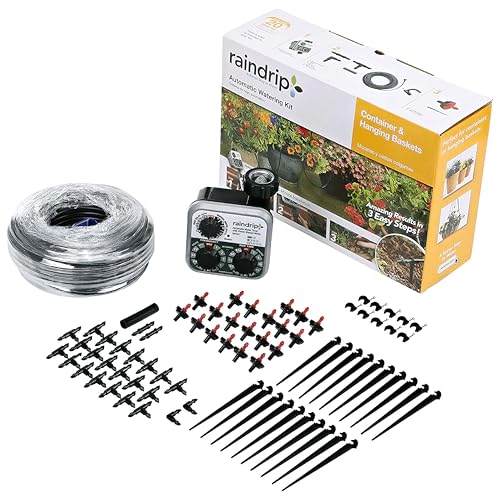
The Raindrip R560DP combines a drip watering system with an integrated timer, designed to water up to 20 plants with 20 included drippers. This setup is ideal for containers, hanging baskets, and planter beds where timed, automated irrigation reduces daily maintenance. Best for: renters or small-space gardeners who want a timer-based, plug-and-play solution.
Consideration: the timer feature is a core benefit, but users should ensure the timer’s scheduling capabilities fit their plant watering needs and climate conditions. The kit emphasizes ease of use and reliable, customizable watering patterns.
JIYANG Solar Automatic Drip Kit

This solar-powered system runs without taps or fixed power sources, using a built-in solar panel and battery to automate irrigation. It offers six timing modes and anti-siphoning features. Best for: balconies, patios, or small gardens without ready access to electricity or water taps. It’s particularly suitable for intermittent watering schedules and low-maintenance setups.
Limitation: consider sun exposure and battery performance in winter or prolonged cloudy periods, which can affect irrigation consistency. The design targets simple, autonomous operation for limited pot and planter setups.
HIRALIY 50ft Drip Kit

The HIRALIY kit emphasizes adjustable emitters and a no-leak brass splitter with individual line control, making it practical for diverse plant types and layouts. Best for: small to medium gardens where separate plants require different watering levels and easy manual adjustments are helpful.
Consideration: while the brass splitter adds durability, ensure compatibility with your existing irrigation components and space for the two lines to run without interference. It’s easy to assemble and use for quick setup.
Irrigation Hose Kit for 120ft System

The 120-foot expandable hose solution supports up to four watering zones across larger plots like patios, raised beds, and greenhouse sections. It emphasizes water savings by delivering moisture directly to roots, potentially reducing overall consumption by a large margin. Best for: larger spaces needing zoned coverage with clear expansion potential.
Limitation: ensure compatibility with the rest of your drip network and confirm the flow rate aligns with your emitters and plant load. This option suits those who want broad coverage with zone-specific control.
Buying Guide: Key Considerations for Automatic Garden Drip Systems
- Space and layout: How large is your garden, greenhouse, or balcony? Choose a kit that supports your area, with room to add zones if needed.
- Main line size and pressure: Kits with 1/2″ main lines generally handle higher water flow and multiple branches better than smaller lines.
- Ease of installation: Quick-connect design and plug-and-play components reduce setup time, especially for beginners.
- Emitters and coverage: Ensure the number and type of emitters match your plant density and watering needs. Adjustable nozzles provide versatility for different plant types.
- Water savings and efficiency: Drip systems aim to minimize evaporation by delivering water near roots. Look for features that reduce waste in your climate.
- Power source and automation: Decide between timer-equipped options, solar-powered units, or manual timers. Consider battery life and reliability for outdoor use.
- Connectivity and expansion: If you plan future growth, choose systems designed to add more zones or extend tubing without reworking the entire layout.
Frequently Asked Questions
- What is the main advantage of a drip irrigation kit over overhead sprinklers?
Answer: Drip systems deliver water directly to the root zone, reducing evaporation and runoff, which improves efficiency and plant uptake. - Do I need a professional to install a drip irrigation system?
Answer: Most kits are designed for DIY installation and come with step-by-step instructions. Complex layouts may benefit from a quick consultation. - How many zones should I plan for in a typical home garden?
Answer: Start with 2–4 zones for larger beds or multiple plant types, and add zones as your layout grows. - Can solar-powered irrigation work year-round?
Answer: Solar-powered systems work best in sunny conditions; in winter or cloudy periods, performance may decline without backup power or watering adjustments. - Is it necessary to use a timer with drip systems?
Answer: Timers help automate watering and ensure consistency, especially for busy or frequently overlooked spaces.