Fruit trees grown indoors or in greenhouses benefit from consistent light exposure that mimics sunny days. This guide highlights top grow lights designed to support flowering, fruit set, and overall health in fruit-bearing plants. Each option offers full-spectrum output, adjustable settings, and energy efficiency to help you manage light across different growth stages while keeping care simple.
Summary of selected products:
| Product | Brand | Key Benefit | Light Type / Features |
|---|---|---|---|
| Orchbloom 3-Head Grow Light with Stand and Timer | Orchbloom | Tall plant coverage with adjustable height and timers | 27W, full spectrum, 4/8/12/16/20H timer |
| GE Grow LED Light Bulb, PAR38 | GE | High efficiency, versatile bulb for fruiting stages | 50 PPF, full spectrum, long lifespan |
| LED Grow Lights With Tripod Stand (yentbokj) | yentbokj | Adjustable height, flexible lighting for varied plants | 4 heads, 15–63″ height, timer, remote |
| SANSI Grow Lights for Indoor Plants | SANSI | High PPFD with advanced cooling for reliability | 36W, 4000K, 65.6 umol/s PPF, lens optics |
| LBW Grow Lights With Stand | LBW | Strong coverage for large plants with auto timer | 72 LEDs, 68″ max height, 4/8/12H timer |
The following sections review five top options. Each product section includes a concise overview, practical features for fruit trees, and a balanced look at how it could fit your space and care routine.
Orchbloom 3-Head Grow Light With Stand

The Orchbloom unit provides a flexible setup for indoor fruit trees that require even light distribution at varying heights. With 126 LEDs delivering 27W of full-spectrum output, this light creates a sun-like environment across 3000K, 5000K, and 660nm wavelengths. The stand supports tall trees and bonsai, keeping plants at an optimal distance for bud development. A built-in 4/8/12/16/20 hour timer helps automate lighting cycles, reducing manual intervention and supporting consistent fruiting cues. This setup suits living rooms, sunrooms, or dedicated growing spaces where space management is essential.
Key considerations for fruit trees: the adjustable height (24″–64″) helps accommodate tree size and canopy growth, while the full-spectrum mix targets both vegetative growth and flowering phases. The timer feature can align light cycles with natural day length, which is beneficial for bloom timing and fruit set. Potential drawbacks include needing more ceiling clearance for tall specimens and ensuring the frame remains stable on uneven surfaces.
GE Grow LED Light Bulb, PAR38
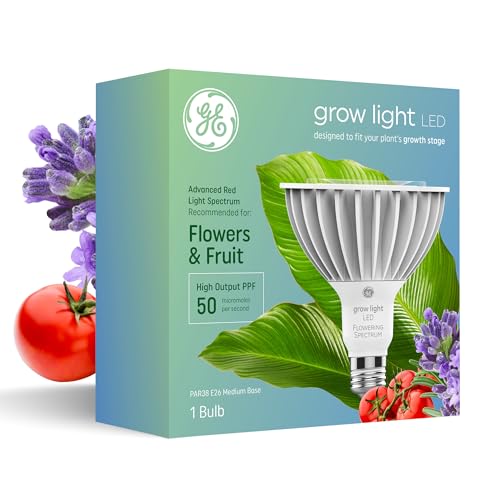
GE’s PAR38 grow bulb is a compact, bulb-style option designed to slot into standard lighting fixtures while delivering full-spectrum output. Rated with a 50 PPF and up to 25,000 hours of life, it can support indoor trees through flowering and fruiting stages by providing both blue and red wavelengths alongside a natural-looking white light. This solution is ideal for spaces where a traditional lamp is used, such as a sunlit corner with a recessed fixture or a desk setup that doubles as a plant corner. It can complement other lighting solutions for a layered light approach in fruit tree care.
For fruit trees, look for bulbs that offer robust red and blue components. The GE PAR38 unit achieves this without requiring a large dedicated fixture. It may, however, lack the intensity needed for very dense canopies or larger trees, so pairing with reflectors or supplemental lights can boost effectiveness in mature or fruiting trees.
LED Grow Lights With Tripod Stand (yentbokj)

This 4-head, full-spectrum grow light from yentbokj combines a 15–63″ adjustable tripod with a 360-degree rotatable gooseneck design. The system supports dynamic light targeting for multiple fruit trees or large specimens placed in the same space. It features three spectral modes (Red/Blue, White, and White + Red + Blue) plus 10 brightness levels and independent head controls. A potent combination of timer options (4/8/12 hours) and a remote control extends automation beyond manual operation, making it practical for varying indoor environments, from drafty basements to bright living rooms.
When used for fruit trees, the ability to fine-tune spectrum and intensity helps promote flowering while protecting against leaf burn on sensitive varieties. The flexible positioning is a real advantage for trees with uneven canopies, though managing multiple heads requires a bit more setup to ensure even coverage across all growth points.
SANSI Grow Lights for Indoor Plants

SANSI emphasizes intensity and efficiency, offering a 36W full-spectrum bulb with secondary optical design to boost PPFD while maintaining energy savings. The 4000K daylight color closely mimics natural light, which can support steady photosynthesis during fruit tree flowering and ripening. With a high-quality lens system, the light distribution is targeted to maximize canopy penetration without overheating. Its long-term reliability is aided by a ceramic-on-heat-sink approach that reduces thermal resistance, helping sustain performance over extended growth cycles.
For indoor fruit trees, SANSI can be a solid core light in a dedicated grow area or greenhouse corner. The compact form factor makes it easy to install in fixtures or clamp-on setups. Consider supplementing with additional units if you need broader coverage for multiple trees or larger pots.
LBW Grow Lights With Stand

LBW’s floor lamp-style grow light is designed for larger plants and trees that require substantial vertical reach. With a sturdy stand and 72 LEDs delivering a full-spectrum output, the light covers a broad area and supports tall canopies without harsh hotspots. The 68-inch maximum extension and adjustable height enable you to position the light for optimal penetration into fruiting branches. The auto timer can be set for 4/8/12 hours to create consistent day-night cycles, simplifying routine care for busy households or classrooms.
In practice for fruit tree care, LBW can be an all-in-one solution for a dedicated plant corner where space is available. If you have multiple trees or larger pots, this option reduces the need for several smaller fixtures. However, very dense canopies may still require additional lighting to reach inner branches.
Buying Guide: Key Considerations For Choosing Fruit-Tree Lighting
- Light spectrum: Fruit trees respond well to full-spectrum light that includes blue for vegetative growth and red for flowering and fruiting. Look for products that specify broad spectral output or list wavelength bands (e.g., 4000K daylight plus red/blue wavelengths).
- Intensity and coverage: PPFD and PPF numbers indicate light strength. For larger trees, prioritize fixtures with higher output or multiple units to ensure even canopy exposure.
- Adjustability: Height, angle, and, in some models, independent head control support coverage as trees grow. Tripod stands and adjustable arms are valuable in dynamic spaces.
- Automation: Timers and remote controls simplify consistent cycles. Auto on/off ensures daily rhythm – beneficial for flowering, bud set, and ripening stages.
- Energy efficiency and heat: LED fixtures offer energy savings and less heat than older technologies. Check thermal design features (e.g., heat sinks) for reliability during longer growth periods.
- Durability and mounting space: Consider stand stability and whether your space requires wall- or ceiling-mounted options or free-standing stands for easy relocation.
- Maintenance: Look for bulbs or LEDs with long lifespans and replaceability. A longer-lasting unit reduces replacement costs and downtime in fruiting cycles.
- Compatibility with existing fixtures: If you already have lamps, PAR38 bulbs can slot into standard sockets, while integrated grow light rigs may require dedicated setups.
In sum, selecting a grow light for fruit trees depends on canopy size, space configuration, and how hands-off you want the system to be. Units with adjustable heights, broad spectral output, steady timers, and multi-head configurations typically offer the best balance of coverage and control for indoor fruiting plants.