Choosing the right grow room light meter helps optimize plant health by ensuring your lighting matches your crops’ needs. The following five meters offer a mix of high accuracy, fast sampling, and practical features like backlit displays and multiple units. Whether you’re growing indoors, taking photos, or monitoring hydroponics, these tools provide objective data to guide lighting decisions and energy use.
Summary of selected products:
| Product | Brand | Lux Range | Key Features |
|---|---|---|---|
| Light Meter Digital Illuminance Meter Handheld Ambient Temperature Measurer | URCERI | 0–200,000 Lux | 4-digit color LCD, MIN/MAX, data hold, auto power off |
| Dr.meter LX1330B Digital Illuminance Light Meter | Dr.meter | 0–200,000 Lux | Peak data, FC/LUX toggle, fast response |
| TOPTES TS-710 Light Meter | TOPTES | 0.1–200,000 Lux | 180° rot. probe, fast 0.5s sampling, backlit display |
| UNI-T UT383 Light Meter Lux Meter | UNI-T | 0–199,900 Lux | 4-digit LCD, backlight, auto shutdown |
| Mcbazel Digital Light Meter With HD Color Screen | Mcbazel | 0–200,000 Lux/FC | 270° rotatable head, 8x/s sampling, LED optimization |
Use this guide to compare how each model handles indoor grow lighting, photography work, and general luminance tracking.
URCERI Light Meter With Ambient Temp
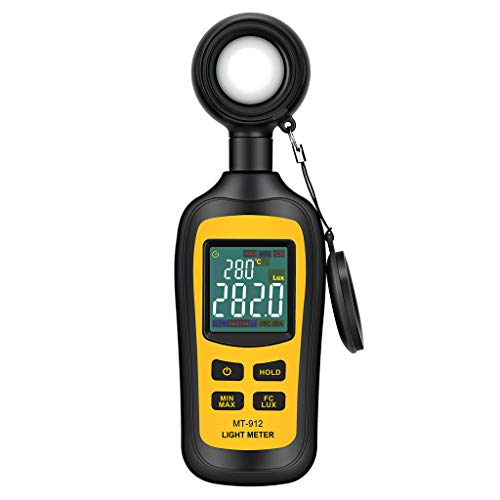
The URCERI illuminance meter measures luminosity from 0 to 200,000 Lux and also reports ambient temperature. It offers high accuracy with 3% rdg ± 8 digits when under 10,000 Lux, and 4% rdg ±10 digits above that threshold. The device features a 4-digit color LCD screen, MIN/Max readings, data hold, auto power off, and a low battery indicator, making it suitable for precise plant lighting planning and general light testing in grow rooms.
Dr.meter LX1330B Illuminance Meter

The LX1330B from Dr.meter provides a high-precision, fast-reading illuminance measurement range up to 200,000 Lux. It supports FC or Lux units, enabling flexibility for gardening and photography workflows. Notable features include a fast response (about 2 readings per second) and the ability to lock peak values, which is useful when measuring brief, high-intensity light bursts and transient lighting conditions in grow environments.
TOPTES TS-710 Light Meter

The TOPTES TS-710 sensor offers 0.1 to 200,000 Lux with a 180° rotating probe for versatile readings. It features a fast response (0.5 seconds) and a large 2.25-inch backlit LCD, making it easier to read in dim grow rooms. It supports both Lux and FC units and is designed for grow rooms, cars, offices, and general lighting projects, providing a broad utility for multi-environment use.
UNI-T UT383 Lux Meter

The UNI-T UT383 provides precise lux readings with a 0–199,900 Lux range and 0–18,500 FC option. It features a large 4-digit LCD with backlight, fast 0.5-second sampling, data hold, max/min functions, overload indication, and auto shutoff for power savings. Its compact design makes it a practical pick for hobbyists, photographers, and plant caretakers who need dependable measurements in tight spaces.
Mcbazel Digital Light Meter With HD Color Screen
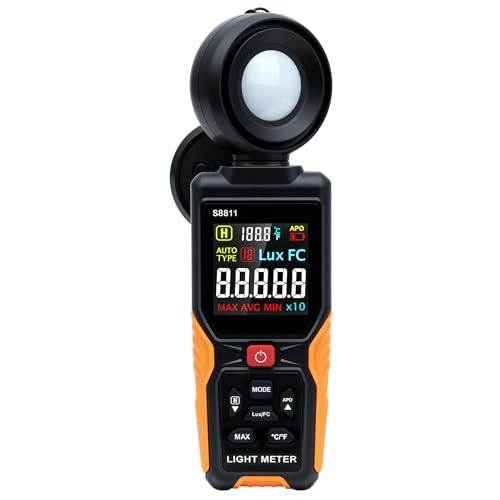
This Mcbazel model offers instant readings with a rapid 8x/s sampling rate and a 270° rotatable head. It is optimized for LED grow lights, plants, and photography, featuring light-source correction coefficients to calibrate for various LEDs. The HD color display improves readability in bright or challenging lighting, while the rotatable probe helps you measure from multiple angles without repositioning the meter, supporting precise lumen and lux work in dynamic grow environments.
Buying Guide: Key Purchase Considerations
- Measurement range and accuracy: Look for meters that cover at least 0–200,000 Lux with a stated accuracy around 3–4% to ensure reliable comparisons across multiple readings and times of day.
- Display readability: Backlit or large LCDs reduce eye strain in dim grow rooms and studios. A color display can further improve legibility in bright conditions.
- Units and conversion: Most meters offer Lux and FC (foot-candles). Choose a model that easily toggles between units to suit horticultural or photography needs.
- Sampling speed: Fast sampling (0.5 s to 2 s) helps track quick lighting changes, such as flicker from artificial sources or sun exposure in greenhouses.
- Functional extras: Features like MIN/MAX, data hold, peak capture, auto power off, and a rotatable sensor head add versatility for testing from different angles and over longer periods.
- Portability and durability: Compact devices are easier to handle in tight grow rooms or studios, but consider build quality and battery life for fieldwork.
- Specialized calibration: For LED-heavy environments, models with LED-specific calibration or coefficients can improve accuracy in modern lighting setups.
- Price-to-feature balance: Higher-priced meters often deliver faster responses and better displays, but entry-level options may suffice for basic readings in hobby grow rooms.
When selecting a grow-room meter, align features with your primary use case: precise plant lighting optimization, photography lighting verification, or general indoor environment monitoring. For plant-focused setups, meters with fast sampling and Lux/FC flexibility are especially valuable, along with a readable display and rugged design for regular use.