Solar powered irrigation valves and controllers offer a maintenance-free way to manage watering schedules across gardens, lawns, and drip systems. This guide highlights five reliable options, detailing their power sources, weatherproofing, valve compatibility, and scheduling capabilities. Whether you want remote solar control or rain-sensing features, these picks help you optimize efficiency and water usage while reducing energy dependence. Read on to compare key features and find the right fit for your irrigation needs.
| Product | Brand | Key Benefit |
|---|---|---|
| DIG RBC 8000 Battery Powered Irrigation Automatic Controller | DIG Store | Battery-powered with flexible scheduling |
| DIG ECO1ILV.075 Solar Powered Controller | DIG Store | Solar powered with rain sensor compatibility |
| DIG ECO1ASV.075 Ambient Light Powered Controller | DIG Store | Ambient light powered, no batteries required |
| LEIT 1 Solar Powered Smart Controller | One Stop Outdoor Store | Smart control with inline valve integration |
| Insoma Outdoor Timer | Insoma Store | Versatile outdoor hose timer with multiple modes |
DIG RBC 8000 Battery Powered Controller With 3/4″ Anti-Siphon Valve
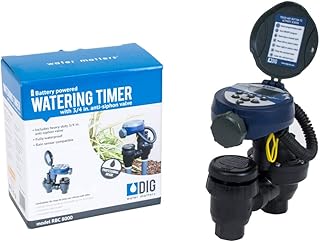
The DIG RBC 8000 combines a battery-powered irrigation controller with a 3/4″ anti-siphon valve, designed for sprinkler or drip systems. It operates on two AA alkaline batteries, enabling a safe 60-second battery change window without losing programming. The unit supports flexible watering with multiple frequencies and four distinct start times, making it suitable for varied plant zones and soil types. An integrated high-resolution LCD and seven control buttons simplify setup and adjustments, while the anti-siphon valve adds a safety layer against backflow. This option is ideal for mid-sized landscapes where AC power is scarce or undesirable.
DIG ECO1ILV.075 Solar Powered Controller With Rain Sensor

This solar-powered DIG ECO1ILV.075 is designed for inline 3/4″ valves and includes rain sensor connections. It eliminates the need for AC power or backup batteries, offering weatherproof operation suitable for outdoor environments. Its compatibility with drip and sprinkler setups makes it a versatile choice for garden beds, yards, or landscape installations. Programming supports up to five start times per day, with watering durations extending up to nearly six hours, enabling precise control over soil moisture and plant needs in variable weather conditions.
DIG ECO1ASV.075 Ambient Light Powered Controller

The ECO1ASV.075 uses ambient light as its power source, removing the need for batteries or mains power. It supports 3/4″ anti-siphon valve configurations and is suitable for both drip irrigation and sprinkler systems. Seven buttons and an built-in LCD provide straightforward programming for schedules and durations, with the appeal of reduced running costs and fewer maintenance requirements due to its solar-based operation. This option is attractive for remote installations or houses with limited electrical access.
LEIT 1 Solar Powered Smart Controller With 1” Inline Valve

The LEIT 1 offers a solar powered smart controller paired with a 1″ inline valve, designed for robust yard irrigation management. Its solar dependency reduces energy costs and the need for electrical hookups, while the inline valve supports easier installation in larger landscape zones. The integrated smart features typically include scheduling, weather-based adjustments, and remote compatibility, making it a practical choice for homeowners seeking scalable irrigation control with lower infrastructure demands.
Insoma Outdoor Garden Hose Timer With Multiple Modes

Insoma’s outdoor hose timer is a flexible option for household irrigation, offering three watering modes (Auto, Manual, Rain Delay) and a wide range of timing settings. It supports watering frequencies from minutes to days and durations from 1 minute to nearly 24 hours. The larger LCD display and a child lock enhance usability, especially in households with children or pets. While not a full controller with inline valve, it provides a reliable, plug-and-go approach for managing simple irrigation zones or seasonal watering schedules on a single hose bib.
Buying Guide: Key Considerations And Comparisons
- Power source: Solar powered units eliminate wiring and battery maintenance. Battery-powered models still offer portability where sun exposure is limited, but require periodic battery changes.
- Valve compatibility: Check valve size (e.g., 3/4″ or 1″), and ensure the controller supports inline valves or anti-siphon configurations to prevent backflow.
- Watering capabilities: Look for multiple start times, adjustable durations, and daily frequencies. Some models offer up to five start times or more and durations of several hours for zone-specific needs.
- Weatherproofing: IP ratings (e.g., IP68) indicate robustness against rain and dust. Outdoor installations demand good sealing against the elements.
- Rain sensing and automation: Controllers with rain delay or rain sensors help conserve water by pausing schedules during wet conditions.
- Display and programming: A larger LCD with intuitive controls reduces setup time. A child lock can prevent accidental changes in households with pets or kids.
- Installation: Inline valve compatibility simplifies setup for larger landscapes, while basic hose timers suit small patios or containers.
- Expandability: If you plan to scale your system, prefer controllers that support additional stations or remote monitoring via standalone apps or accessories.
- Durability and warranty: Outdoor devices should withstand temperature fluctuations and exposure. Review manufacturer warranties for long-term reliability.
- Environmental impact: Solar-powered options reduce electricity use and emissions, contributing to a greener irrigation approach.
When selecting among these options, consider the size of your landscape, the number of zones, and how much sun exposure your installation will receive. For precise plant care, prioritize models with multiple start times and longer run durations, along with rain delay features to adapt to seasonal weather. If electrical access is constrained, solar-powered controllers with durable housings are advantageous. Battery-based controllers are suitable where sun exposure is inconsistent but backup flexibility is valued.