Quick, accurate soil testing helps gardeners tailor fertilizer and watering to your plants’ real needs. The following no-wait soil test kits offer rapid results, simple at-home use, and clear guidance based on nutrient and pH readings. Each option below is designed for American gardeners who want reliable data without waiting days for lab reports.
| Product | |||
|---|---|---|---|
| Rapitest Soil Test Kit | Colorimetric Home Kit | 20 tests, pH/N/P/K | Minutes |
| MySoil Soil Test Kit | Mail-in Professional Lab | 13 plant-available nutrients | 6–8 days |
| Soil Test Kit – 140 Test | Liquid Colorimetric Kit | Comprehensive pH and major nutrients | Minutes |
| Soil pH Test Kit (125 tests) | Test Strips with Cylinders | Extensive pH coverage | Minutes |
| HSLGOVE 2-in-1 Soil Tester | Moisture + pH Meter | Simultaneous moisture and pH readouts | Seconds (moisture) / Minutes (pH) |
The following sections spotlight five top picks that balance speed, clarity, and usefulness for American gardens and lawns. Each entry includes a direct link to Amazon, a quick image reference, and a summary of its key features.
Rapitest Soil Test Kit For Gardens
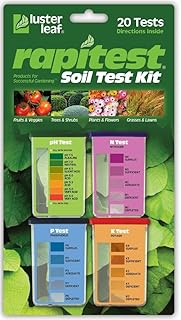
The Rapitest kit from Luster Leaf Store provides quick, at-home results for soil pH, nitrogen, phosphorus, and potash. Its patented color comparators use an easy-to-use capsule system, enabling up to 20 tests (5 per variable). This kit is designed to help homeowners test multiple locations in a garden or yard, delivering actionable data in a short time frame.
Key features include:
- Tests: pH, Nitrogen (N), Phosphorus (P), Potash (K)
- 20 tests total; 5 per parameter
- Compact testing system with color comparators
- All necessary components included for quick testing
MySoil Soil Test Kit

MySoil offers a complete soil analysis with a professional-grade interpretation. This kit emphasizes fast, accurate results via mail-in laboratory analysis that measures 13 plant-available nutrient levels, including pH. The service provides tailored recommendations designed to meet a wide range of growing scenarios, from lawns to hydroponics.
Highlights include:
- Laboratory analysis with 13 plant-available nutrients
- Fast results, typically within 6–8 days
- Applicable to lawns, vegetables, flowers, trees, and more
- Compared to home meters, higher accuracy for nutrient levels
Soil Test Kit – 140 Test

This 2026 version provides a broad liquid test approach to essential soil parameters, including pH, ammonia, nitrogen, phosphorus, and potassium. It is designed to deliver a holistic view of soil fertility and health in one kit, with practical fertilizer recommendations aligned to your specific soil readings.
Core points:
- Comprehensive set of nutrients tested in one kit
- Helps guide precise fertilizer application
- Useful for varied settings—lawn, garden, landscape, hydroponics
- Time-efficient compared with sending samples to a lab
Soil pH Test Kit: 125 Tests

This kit uses upgraded 125 soil pH test strips with measuring cylinders to improve accuracy and ease of use. It includes colorimetric blocks for precise pH readings and is designed to help gardeners track soil acidity over time in different garden spots, lawns, and containers.
What to know:
- 125 tests provide extensive coverage for large gardens
- Includes measuring cylinders for consistent sample preparation
- Color blocks aid in precise pH interpretation
- Ideal for ongoing soil monitoring and pH management
HSLGOVE 2-in-1 Soil Tester

This 2-in-1 tester combines a soil moisture meter and a soil pH meter in one device. It features a battery-free design and a dual-dial readout that shows moisture and pH simultaneously. The single probe aims to minimize root disturbance and provides quick, in-situ readings for indoor and outdoor plants, lawns, and gardens.
Key takeaways:
- Battery-free operation with dual-dial readout
- Simultaneous moisture and pH measurement
- Single robust probe minimizes root damage
- Suitable for indoor and outdoor use, including lawns and greenhouses
Buying Guide: Key Purchase Considerations and Comparisons
When selecting a no-wait soil test kit, consider the following factors to ensure you get reliable data and actionable guidance:
- Purpose and scope: Decide whether you need quick pH and nutrient readings at home (colorimetric kits) or a professional lab analysis with tailored recommendations (mail-in kits like MySoil).
- Speed vs. accuracy: Home kits provide fast results but may have limitations in precision. Lab-based analyses offer deeper nutrient insight but require several days.
- Measured parameters: Identify which nutrients matter most for your plants (N, P, K, pH, ammonia) and choose a kit that covers those metrics.
- Sample handling: Abide by the kit’s instructions on sample depth, number of test spots, and mixing to ensure representative results.
- Cost and value: Consider how many tests you receive, whether the kit includes all necessary components, and whether ongoing testing is feasible for your garden’s size.
- Ease of use: For beginners, colorimetric strips and clear color comparisons reduce interpretation errors, while advanced users may prefer more data-interpretation support.
- Scalability: Large lawns or gardens may require kits with many tests (e.g., 125 strips) or a combination of home tests plus periodic lab analyses.
- Data interpretation: Look for kits offering practical recommendations (fertilizer types, application rates, timing) rather than raw numbers alone.
- Durability and storage: Ensure components are well-packaged and that color charts or measuring tools remain readable over time.
- Environmental considerations: Some kits emphasize responsible fertilizer use to prevent runoff and soil degradation.
Overall, for immediate, on-site results with straightforward interpretation, colorimetric home kits like Rapitest or 125-strip pH kits are ideal for quick lawn and garden checks. For plants with complex needs or for precise nutrient management across varied soil types, a mail-in professional analysis such as MySoil provides deeper data and actionable plans. A practical approach in many American gardens is to pair a fast home test for routine monitoring with periodic lab analyses to validate and refine long-term soil fertility strategies.