Choosing the right starter fertilizer can help new grass establish faster, thicker, and more evenly. This guide reviews top options designed for seedings, sod, and overseeding, focusing on early growth, root development, and nutrient availability. Each product features NPK ratios and specialty additives to support fresh lawns. Read on to compare tailored blends, application methods, and performance notes to pick the best starter fertilizer for your grass seed project.
| Product | Key Benefit | Typical Coverage |
|---|---|---|
| Scotts Turf Builder Starter Fertilizer for New Grass | Thicker, quicker growth; nutrient-dense for seed and sod | Up to 5,000 sq. ft. |
| Scotts Turf Builder Triple Action Built For Seeding | Weed prevention plus starter fertilizer for new lawns | Up to 1,000 sq. ft. |
| Extreme Grass Growth Lawn Booster | Liquid growth boost with humic acid for rapid establishment | Varies by sprayer |
| GreenView Spring or Fall Lawn Starter Fertilizer | Seasonal starter for bulk coverage and lawn health | Up to 15,000 sq. ft. |
| Lawn Synergy Starter Fertilizer 15-20-10 | Fast germination, deep root growth, AMP-XC biocatalyst | 18 lbs. |
Scotts Turf Builder Starter Fertilizer for New Grass

This starter fertilizer is formulated to help new grass seed develop a robust root system and emerge thicker, about 70% more dense and 35% quicker than unfed seed. The 24-25-4 ratio supplies essential nitrogen, phosphorus, and potassium to support seedling growth, sod, and plugs. Ideal when planting seed to maximize establishment and early vigor.
Scotts Turf Builder Triple Action Built For Seeding

Designed for use when planting new grass, this product combines a starter fertilizer with pre-emergent weed control. It helps prevent common lawn weeds like dandelions and crabgrass for up to six weeks without harming new grass, while jump-starting development and providing ongoing nutrition to protect against heat and drought. Best for seed lots where weed pressure is a concern.
Extreme Grass Growth Lawn Booster

This liquid starter formula uses a humic acid-rich blend to enhance vertical and lateral growth, making it suitable for new lawns and sod/seed projects. Delivered via a ready-to-use hose-end sprayer, it provides nitrogen and phosphorus in a production-grade concentration to support rapid establishment and nutrient uptake, particularly in nutrient-deficient soils.
GreenView Spring or Fall Lawn Starter Fertilizer

GreenView’s seasonal starter is designed for both spring and fall application windows, helping new seedlings establish with steady nutrient delivery. It covers large areas (up to 15,000 sq. ft.) and aims to balance early growth with long-term lawn health, making it a practical option for larger projects or established turf renovations.
Lawn Synergy Starter Fertilizer 15-20-10
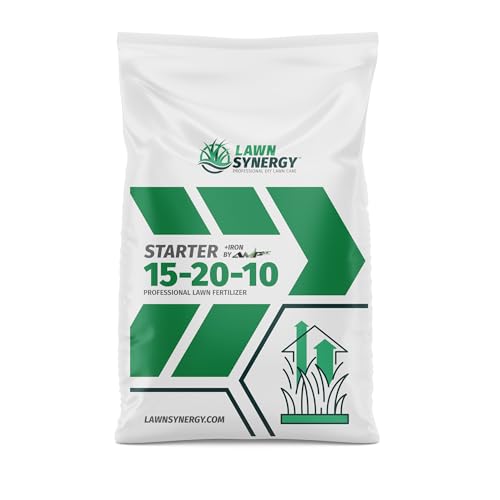
Optimized for new lawns, seedings, and overseeding, this 15-20-10 formula includes iron for deeper green color and AMP-XC biocatalyst technology to boost nutrient uptake. The product aims to deliver fast germination, strong root systems, and resilient growth with an emphasis on soil health and nutrient efficiency.
Buying Guide
- NPK balance: Look for blends around 10-20-10 or higher first numbers that support root development and seedling vigor. Higher phosphorus levels (the middle number) aid root growth in seed-start scenarios.
- Weed prevention vs. growth: Some formulas include weed control; use these only where weed pressure is a concern and you’re applying during the appropriate season for seed establishment.
- Application method: Granular formulas require watering-in; liquid concentrates and hose-end sprayers offer faster nutrient delivery but may require more frequent applications depending on irrigation and rainfall.
- Soil health supplements: Humic acids and biocatalysts can improve nutrient uptake and microbial activity, potentially boosting germination and root expansion.
- Coverage and area: Match product coverage to your lawn size. Large-area starters are cost-efficient for big yards, while smaller bags suit seed patches or tight spaces.
- Season and climate: Spring and early summer often provide ideal conditions for seed germination. In hotter regions, consider products designed to tolerate heat and drought stress.
- Safety and compatibility: Read label directions to ensure compatibility with your seed type (fescue, Kentucky bluegrass, or other varieties) and avoid applying during extreme temperatures or drought forecasts.
When selecting a starter fertilizer, consider your lawn’s soil health, seed type, and local climate. The products reviewed here offer varied NPK ratios, weed-control components, and nutrient delivery systems to support initial germination, root development, and steady growth. For best results, follow label instructions, apply uniformly, and water adequately to support seed establishment and root growth during the critical early weeks of a new lawn.