Choosing the right moisture meter can simplify plant care, helping you water precisely when needed. This guide analyzes top options for home gardeners and indoor plant enthusiasts, highlighting accuracy, ease of use, and value. Below, you’ll find five reliable meters, followed by a buying guide to help you compare features such as battery requirements, display type, and measurement scope.
| Product | Brand | Key Feature |
|---|---|---|
| XLUX Soil Moisture Meter | XLUX | Immediate deep-soil readings with a large dial |
| YAMRON 4-in-1 Soil Tester | YAMRON | Moisture, pH, temperature, sunlight |
| XLUX Long Probe Deep Use | XLUX | 5.5-inch deep probe for large pots |
| IRTOV 4-in-1 Soil Meter | IRTOV | pH, moisture, temperature, light with backlit LCD |
| DAQVQ 2-in-1 Soil Meter | DAQVQ | Dual-screen, battery-free testing |
The following sections present five top-rated options, each with a concise overview of what they measure, how they display results, and typical use cases for different kinds of gardens. All selections are battery-free when noted, and designed for quick, readable results in daylight or low light.
XLUX Soil Moisture Meter: Quick, Clear Readings
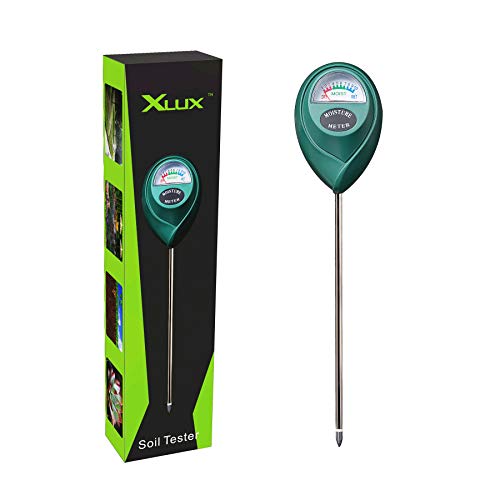
Designed for simplicity, this meter focuses on accurate soil moisture detection—the core need for most gardeners. The probe reaches below the surface to determine whether soil is dry, moist, or wet, enabling precise watering decisions. Its large dial is easy to read and uses ten scales across three zones, so interpretation is quick even for beginners. A caution note: avoid leaving the metal tip in soil for more than five minutes to prevent corrosion, and remove the meter after taking a reading.
YAMRON 4-in-1: Moisture, pH, Temperature, Sunlight

This multifunction device combines soil moisture with pH, temperature, and sunlight measurements. The backlit LCD makes readings clear in dim conditions, and the device uses four AAA batteries (not included) to power the display. It’s ideal for gardeners who want a single tool to monitor multiple growing conditions. Quick, practical measurements help you determine not only when to water, but also if soils are trending toward acidic or alkaline conditions that affect nutrient uptake.
XLUX Long Probe Deep Use: Deep Pot Monitoring

This model extends the probing depth to reach the bottom of large pots, making it useful for bigger containers and deep-rooted plants. The 5.5-inch probe allows more accurate readings in dense media, while the dial keeps things simple with three moisture zones across ten scales. As with other XLUX meters, avoid prolonged soil contact to prevent corrosion of the metal tip, and use the device for quick, on-the-spot assessments of irrigation needs.
IRTOV 4-in-1 Meter: pH, Moisture, Temperature, Light

IRTOV’s 4-in-1 meter provides a broad set of data for gardeners who want a more scientific approach to plant care. The device measures soil pH, moisture, temperature, and light level, and presents results on a large backlit LCD for easy reading day or night. The user can quickly gauge watering needs and also monitor pH trends that may influence nutrient availability. Battery usage varies by model, so check included accessories when purchasing.
DAQVQ 2-in-1: Battery-Free Moisture And pH

DAQVQ combines two essential readings—soil moisture and pH—without requiring batteries. Its dual-screen design displays moisture levels and pH values in real time as you insert the probe into soil. This makes it a practical option for beginners who want straightforward, battery-free operation. The device is easy to operate and reduces guesswork around watering and soil acidity, helping gardeners optimize irrigation schedules.
Buying Guide: Key Purchase Considerations
- Measurement scope: Decide whether you need just moisture or additional metrics like pH, temperature, or light. 4-in-1 meters provide broader insight but can be more complex to read.
- Display type: Dial gauges are fast and familiar, while digital LCD displays offer precise readouts and easier interpretation in low light. Some meters include backlighting for night use.
- Probe length and depth: Longer probes reach deeper into soil, which benefits larger pots and dense media. Shorter probes are adequate for small containers and surface-level checks.
- Power requirements: Battery-free models are convenient for simple moisture checks, but digital meters with screens often require batteries. Consider replacements and durability.
- Durability and maintenance: Look for rust-resistant probes and a design that minimizes corrosion. Avoid leaving meters inserted for extended periods in order to prolong life.
- Calibration and accuracy: Some meters provide quick, approximate readings; others offer higher precision suitable for serious gardening or greenhouse work. Consider how critical precise readings are for your plants.
- Ease of use: For beginners, a meter with a large, readable display and minimal steps to read results is ideal. Complex interfaces may slow down routine checks.
- Price and value: Compare features relative to price. A 4-in-1 meter is valuable if you regularly monitor multiple soil conditions; otherwise, a dedicated moisture meter may suffice.
In practice, most home gardeners benefit from starting with a reliable moisture meter and then upgrading to a 4-in-1 model if they need more soil insights. For deep pots or planters, choose a meter with a longer probe. For low-light areas, prioritize a model with a backlit display. Battery-free options are simplest, while digital meters excel in clarity and data-rich readings.