This article highlights five top rock wool options for propagation, germination, and hydroponic growth. Each product is evaluated for water retention, aeration, transplant ease, and overall suitability for seeds, cuttings, or clones. Use these picks to optimize root development and high germination rates in soil-less systems.
| Product | Brand |
|---|---|
| Halatool 1 Inch Rockwool Cubes Starter Plugs | Halatool |
| WANGSHIQI Rockwool Cubes, 28 Pack | WANGSHIQI |
| VidaWool 6″ Blocks | VIDAWOOL |
| Redrock Rockwool Cubes 6″ x 6″ | Twin Canaries |
| JolliKids 252 Pieces Rockwool Cubes | JolliKids |
Halatool 1 Inch Rockwool Cubes Starter Plugs

Halatool provides four sheets totaling 200 rockwool cubes, ideal for seed starting, cuttings, and clone propagation. The material is basalt-based with strong water absorption and air permeability to support robust root growth. To use, cut cubes to size, soak briefly in a nutrient solution to adjust EC and pH (target pH around 5.5), then maintain appropriate moisture, light, and temperature for germination before transplanting once roots reach about 0.5–1 inch.
WANGSHIQI Rockwool Cubes, 28Pack

WANGSHIQI’s 28-pack features soft, uniform rock wool blocks with good water absorption and air permeability to support balanced root system development. Blocks can be transplanted whole or cut with scissors. Soak in nutrient solution for about 10 seconds and adjust to pH around 5.5. Maintain appropriate water, light, and temperature to improve germination, then transplant when roots penetrate 0.5–1 inch.
VidaWool 6 Inch Blocks

VidaWool 6″ blocks are designed for the second growth stage with Hydro-Xtend water dispersion for even nutrient distribution. They feature rapid saturation (<15 seconds), UV protection to shield roots, and consistent moisture retention. Submerge blocks in nutrient solution to pH 5.5–6.0 for about 15 minutes, or spray until fully saturated, then place on the growing surface after drainage.
Redrock Rockwool Cubes 6″ x 6″
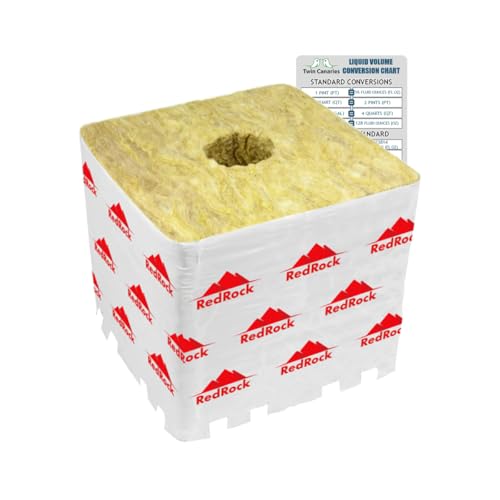
This 6” x 6” stone wool starter block features a 42/40 planting hole designed for clean transplanting of plugs and cuttings. It combines high moisture retention with balanced drainage to support larger root systems during vegetative growth, making it suitable for hydroponics and indoor cultivation.
JolliKids 252 Pieces Rockwool Cubes

JolliKids offers 12 sheets of 21 cubes each plus 10 plant name tags, designed for seed germination and seedling growth. The plugs provide strong water retention and ventilation. Pre-soak in a slightly acidic nutrient solution (pH 5.5–6.5) and monitor pH throughout cultivation for optimal root development and transplant readiness.
Buying Guide: Key Considerations When Choosing Rock Wool
- Size and density: Choose cube sizes that fit your propagation tray and space. Denser rock wool generally holds moisture longer, while lighter blocks promote faster aeration.
- Water absorption and air porosity: Balanced moisture retention and air flow support robust root systems. Look for products that advertise uniform texture and good drainage.
- pH and nutrient compatibility: Most rock wool requires a slightly acidic environment (pH ~5.5–6.0). Ensure EC/pH adjustments are feasible with your nutrients.
- Transplant ease: Some blocks are easier to transplant than others (whole blocks vs. pre-cut holes). Consider whether you prefer pre-drilled holes or flexibility to customize.
- Usage scenario: For seeds, cuttings, and clones, verify that the product supports germination, seedling vigor, and subsequent rooting.
- Cleanliness and sterility: Choose inert, sterile rock wool to minimize contamination risk in early growth stages.
- Package contents: Kits with multiple plugs or sheets offer cost efficiency and flexibility for scaling from germination to cloning.