Winter weather can threaten fruit trees, shrubs, and potted plants. The right frost blankets create a barrier against freezing temperatures while allowing air and light to reach roots and foliage. This guide reviews five widely available options, highlighting size, material, and features to help American gardeners choose the best fruit tree covers for winter without sacrificing growth in the coming season.
Summary of Selected Products
| Product | Size (L x W) | Material/Weight | Key Feature |
|---|---|---|---|
| MIXC Plant Covers (47.2″×70.8″) | 47.2″ × 70.8″ | Non-woven fabric, 1.77 oz/yd² | Drawstring opening for quick coverage |
| SCRUBIT Plant Covers (60 x 70 in.) | 60″ × 70″ | Thick, durable fabric | Zipper and drawstring for secure fit |
| SORANGEUN Frost Cover (100”×120”) | 100″ × 120″ | 2.8 oz/yd² heavy-duty fabric | Large single-cover option with drawstring and zipper |
| SORANGEUN Frost Cover (95”×80”) | 95″ × 80″ | 2.8 oz/yd² heavy-duty fabric | Side zipper and drawstring for secure fit |
| KXCOFTXI Frost Protection Cover (95″×79″) | 95″ × 79″ | 2.2 oz/yd² breathable fabric | Breathable and moisture-permeable |
Introduction
The following five products offer varying sizes, weights, and closure methods to fit a range of fruit trees and shrubs. When choosing, consider tree height, canopy width, wind exposure, and whether you’ll cover multiple plants with a single large cover or individual bags. All options prioritize breathability to prevent condensation while offering insulation for winter protection.
MIXC Plant Covers: 47.2″×70.8″

These large plant covers are designed for plants about 55″–70″ tall and 84″–94″ around. Made from a heavy non-woven fabric (1.77 oz/yd²), they provide 40%–60% light transmittance with an estimated 3°–8°F of freeze protection. The drawstring opening enables quick coverage, while the fabric’s breathability helps maintain air exchange around plants.
SCRUBIT Frost Covers: 60 x 70 in.

SCRUBIT’s covers are positioned as extra thick and durable, suitable for protecting larger trees and shrubs over winter. They feature a zipper and drawstring for secure closure, with a design that aims to support growth while resisting harsh conditions. The material is described as thick enough to protect yet translucent enough to allow sunlight to reach plant canopies.
SORANGEUN Frost Cover: 100”×120”
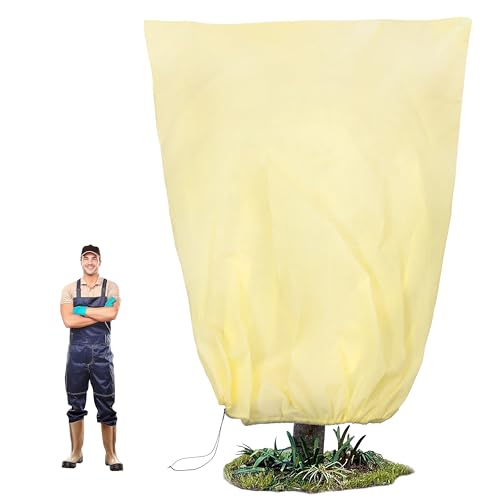
This extra-large frost cloth is suitable for larger shrubs and small trees, providing substantial coverage with a heavy-duty 2.8 oz/yd² fabric. It includes a zipper and a drawstring to secure the base, helping to prevent wind intrusion and cold drafts while permitting airflow and light transmission to roots and foliage.
SORANGEUN Frost Cover: 95”×80”

The 95″×80″ version offers a similar heavy-duty fabric and a drawstring with a side zipper, enabling secure coverage for mid-to-large fruit trees and shrubs. This size is practical for backyards with multiple plants and provides robust protection without bulk for storage.
KXCOFTXI Frost Protection, 95”×79”

KXCOFTXI’s large 95″×79″ frost cover uses a breathable 2.2 oz/yd² non-woven fabric to balance warmth and airflow. The design prioritizes moisture-permeability, which helps prevent condensation while guarding against frost. It suits larger shrubs and trees, especially where airflow management is important in windy winter zones.
Buying Guide
- Size and fit: Measure plant height and canopy width. Choose covers that can fully enclose the plant with some slack for secure closures. Large, single-piece covers are convenient for multiple shrubs, while smaller bags work well for individual trees.
- Material and weight: Heavier fabrics offer better insulation but may be less breathable. Look for values around 2.0–2.8 oz/yd² for a balance of warmth and air exchange.
- Closure mechanisms: Zippers and drawstrings simplify covering and removal. Side zippers reduce plant disturbance during maintenance.
- Light transmission: Partial translucence allows sunlight and photosynthesis to continue, supporting growth while protecting from frost.
- Durability and reuse: Reusable non-woven fabrics provide cost efficiency over multiple winters. Check reinforced seams and drawstring durability for windy conditions.
- Storage and care: When not in use, dry covers completely to prevent mold. Store in a cool, dry place away from direct sunlight to preserve material integrity.
- Weather considerations: In extreme cold or heavy snowfall areas, combine covers with other protection strategies, such as windbreaks or micro-climate strategies around plants.