Finding the right solar fence charger helps protect cattle, horses, and other livestock while reducing maintenance. This guide highlights five top options, focusing on durability, battery life, and easy installation. Each product section includes practical features to match real farm needs, from remote pastures to day/night operation. The following comparisons help you choose energy-efficient, low-maintenance energizers that keep predator threats and intruders at bay without relying on continuous power access.
| Product | Brand | Best For |
|---|---|---|
| Andmon 50 Miles Solar Electric Fence Charger | ANDMON | Large pastures, cattle, horses, wildlife control |
| 10 Miles Solar Electric Fence Charger | ANDMON | Mobility, strip grazing, smaller fields |
| S1000 1 Joule Solar Fence Charger | Realpoultry | Rotational grazing, versatile fencing |
| 24 Hour Solar Electric Fence Charger | Epoify | Continuous protection, up to 10 miles |
| ANDMON MINI400 30 Miles Solar Electric Fence Charger | ANDMON | Medium-to-large pastures, day/night mode |
Andmon 50 Miles Solar Electric Fence Charger

The Andmon 50 Miles Solar Electric Fence Charger delivers 0.95 joules of energy, designed for up to about 55 miles of fencing in appropriate setups. It supports livestock such as cattle, horses, and sheep, and helps deter wildlife and intruders from garden or farm plots. A robust solar panel plus DC charging option provides flexibility in energy supply, with a built-in 12V/12AH battery enabling operation for up to 14 days without sunlight. Installation is versatile, compatible with Y-posts, wooden posts, and various fencing setups. This makes it suitable for larger pastures where dependable power backup matters.
10 Miles Solar Electric Fence Charger

This 10 Miles Solar Electric Fence Charger is compact and easy to relocate, ideal for strip grazing and temporary fence lines. It energizes up to about 2 miles of fencing and features built-in solar panels with an internal GEL battery. The unit is designed for rugged field use, with a durable build and simple mounting options. Its energy management targets reliability in low-light conditions, supporting continuous operation for day and night use. This is a practical option for farms needing portable fencing while maintaining steady livestock control.
S1000 1 Joule Solar Fence Charger

The S1000 model offers a 0 joule output with 1 joule stored energy, capable of powering up to 50 miles of fencing depending on wire type and the number of strands. It is designed for rotational grazing and wildlife exclusion, with portability via a 12V/12AH sealed lead-acid battery and a 15W solar panel. This charger is suited for remote pastures where continual power access is limited. Easy installation is aided by built-in solar panels and a GEL battery, and it can be mounted on a steel rod to connect quickly to the fence line.
24 Hour Solar Electric Fence Charger

This 24 Hour Solar Electric Fence Charger provides 10 miles of coverage with 24/7 protection from livestock and predators. The portable, lightweight design includes a lithium-ion battery and a rechargeable solar panel to ensure all-day and all-night operation. It claims year-round reliability in varied weather, ensuring that fences remain energized when sunlight is available and sufficient to power through cloudy days. The unit is well-suited for larger farms needing dependable, low-maintenance fencing across long perimeters.
ANDMON MINI400 30 Miles Solar Electric Fence Charger
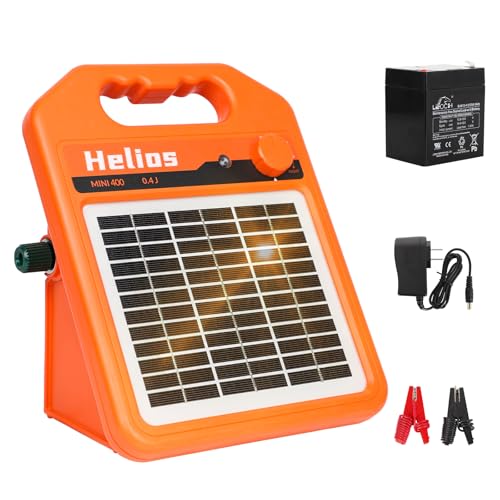
The Andmon Mini400 provides 0.4 joule output (0.3 joule low-impedance design) and supports up to about 10 miles of fencing. It includes Day/Night Mode for energy efficiency, pulsing more rapidly during the day and slower at night. This model can be powered by solar energy or a DC charger, offering flexibility in varying environments. Setup is straightforward, with compatibility across Y, T, and wooden posts, making it adaptable for different fencing configurations in mixed-use pastures. This is a solid choice for medium-sized operations needing energy efficiency and flexible power options.
Buying Guide: Key Purchase Considerations
- Coverage and voltage: Match the charger’s miles of fence capability to your pasture size, typical wire type, and number of strands. Higher joule output tends to deliver deeper deterrence on longer runs.
- Power source and reliability: Look for solar panels paired with a robust battery. DC charging as a backup helps maintain energization during extended cloudy periods or at remote sites.
- Portability and installation: For rotating pastures or strip grazing, choose a charger with lightweight design and multiple post-compatibility options (Y/T/Wooden posts) and easy mounting.
- Dual-mode operation: Units with day/night modes and adjustable pulse intervals can optimize energy use, extending battery life in varying light conditions.
- Durability: Weather-resistant housings, UV protection, and impact resistance improve long-term performance in outdoor environments.
- Maintenance and alerts: Some models incorporate alarms or status indicators for short circuits or connection issues, facilitating quick response and uptime.
- Battery life and replacement: Reputable models use GEL or lithium-based batteries with long cycle life. Consider ease of replacement and availability.
- Scalability: If you anticipate pasture expansion, choose energizers with higher potential coverage or add-on capabilities with the same brand ecosystem.
In evaluating options for cattle and other livestock, prioritize a model that balances energy output, battery reliability, and low-maintenance operation. For remote or large pastures, solar-powered units with durable construction and flexible mounting generally provide the best long-term value. For smaller or portable applications, compact models with day/night optimization offer practical advantages without sacrificing security.