Hydroponics enthusiasts rely on rock wool for its excellent water retention, aeration, and consistent moisture delivery. The following selections highlight diverse sizes and pack options to fit seed starting, cloning, and transplanting needs. This guide compares material quality, ease of use, and how each option supports robust root development in soil-less systems. Whether you’re germinating seeds or propagating cuttings, these rock wool solutions are designed to optimize germination rates and plant vigor.
style=”display:none;”>Summary Table of Chosen Products
| Product | Size | Plugs / Cubes | Key Benefit |
|---|---|---|---|
| Halatool 1 Inch Rocks | 1 inch | 200 plugs | High water absorption; good air permeability |
| Legigo 2 Inch Rockwool Cubes | 2 inch | 96 plugs | Fast root penetration; easy to cut |
| WANGSHIQI 28 Pack | Various (28-pack) | 28 plugs | Balanced porosity and moisture handling |
| VidaWool 6″ Blocks | 6 inch | 6 blocks | Uniform water distribution; UV protection |
| Legigo 1.5 Inch 4 Sheet | 1.5 inch | 196 plugs | High-volume starter plugs; easy rooting |
Halatool 1 Inch Rockwool Cubes Starter Plugs

The Halatool set includes four sheets of 1-inch rockwool, totaling 200 plugs. Manufactured from basalt fibers and processed for soft texture and strong air permeability, these cubes support rapid root penetration and even nutrient uptake. The product is designed for seed starting and cuttings in hydroponic or soilless systems, with easy preparation steps: cut to size, soak briefly in nutrient solution to adjust EC and pH (target roughly pH 5.5), then maintain appropriate moisture and light. Transplant once roots breach the cube by about 0.5–1 inch.
Key features include robust water absorption, controlled fiber formation for consistency, and clear usage guidelines that emphasize pH management and moisture control. The value package makes it suitable for hobbyists and small setups seeking dependable germination media with predictable outcomes.
Legigo 2 Inch Rockwool Cubes For Hydroponics
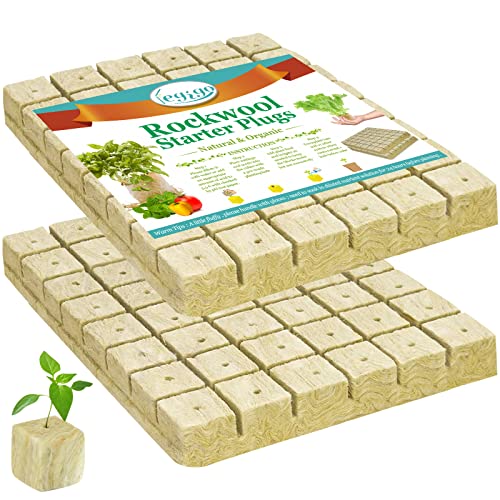
This 2-inch Legigo kit provides 96 plugs across two sheets, engineered for seed germination, cuttings, and clones. The material is basalt-based rockwool, centrifuged and compressed to deliver a soft texture that eases root penetration while maintaining structural integrity. A practical setup tip is to cut the cubes with a knife and soak briefly (about 10 seconds) in a diluted nutrient solution or adjust with citric acid to reach roughly pH 5.5. After roots reach 0.5–1 inch, transplant to a substrate or hydroponic system.
Legigo emphasizes ease of use and reliable moisture handling, helping growers achieve higher germination and transplant success rates. Its compact size fits many starter trays and propagation chambers, making it a versatile choice for home growers and small-scale operations.
WANGSHIQI Rockwool Cubes (28 Pack)

The WANGSHIQI option focuses on a 28-pack configuration designed for versatile propagation. The blocks are made from basalt and chalk fibers, delivering a soft, uniform texture with strong water absorption and breathability. They’re suitable for seed germination, cuttings, cloning, and hydroponic or aeroponic systems. The product notes recommend soaking the cubes for ~10 seconds in a nutrient solution and adjusting pH to around 5.5. Once the root system reaches about 0.5–1 inch, transplant to soil or hydroponics.
Users benefit from balanced moisture distribution and the ability to plant whole blocks or separate the pieces for transplantation. The blocks are designed to support rapid seedling establishment while minimizing transplant shock in various growing environments.
VidaWool 6″ Blocks For Hydroponics

VidaWool’s 6-inch rock wool blocks are engineered with Hydro-Xtend water dispersion technology to promote uniform water and nutrient distribution across the root zone. The blocks are designed for second-stage growth, providing consistent crop performance and efficient water use with a submersion-friendly saturation time of under 15 seconds. UV protection helps keep roots in darkness, reducing photo-stress. To use, saturate the blocks in nutrient solution at pH 5.5–6.0 for up to 15 minutes or spray until fully saturated, then drain before placing on the growing surface.
This option is ideal for growers pursuing uniform root zones and scalable propagation, especially in systems that require precise irrigation control and steady nutrient delivery during early vegetative stages.
VidaWool 1.5″ Seed Starter Plugs
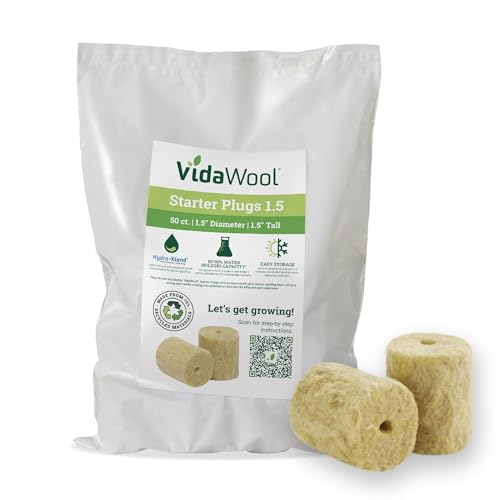
VidaWool’s 1.5-inch seed starter plugs are designed with Hydro-Xtend technology for even water and nutrient distribution and feature a high water-retention capacity (85–95%). They sink quickly, enabling efficient use of resources. The plugs are durable when wet and dry, resisting punctures to protect delicate roots. They are ready to use with minimal storage requirements and offer a guided protocol for submersion in nutrient solutions at pH 5.5–6.0 for up to 15 minutes. Seeds or clones placed in pre-drilled holes can then be grown until ready for transplanting into blocks or a system.
These plugs provide a practical solution for propagating seedlings and clones, especially for growers prioritizing quick saturation, durability, and ease of transplant readiness in hydroponic or soil-less setups.
JolliKids 252 Pieces Rockwool Starter Plugs

The JolliKids set includes 252 rockwool plugs across 12 sheets with 21 cubes per sheet, plus 10 plant name tags. The plugs are pre-drilled to simplify inserting seeds or cuttings, and they offer strong water retention with good air permeability for healthy seedling development. Usage guidance recommends pre-soaking in a mildly acidic nutrient solution (pH 5.5–6.5) and ongoing monitoring of pH to maintain root-friendly conditions. This package is well-suited for experiments or multi-plant trials due to its high plug count and labeling aids.
Overall, these plugs support reliable germination and early growth, with a focus on ease of use and maintaining stable root environments across varied plant types.
Buying Guide: Rock Wool For Hydroponics — Key Purchase Considerations
- Size and pack size: Choose cubes or plugs that fit your propagation tray and space. For large productions, multi-pack options reduce reordering frequency; for beginners, smaller starter packs help manage costs and learning curves.
- Material quality: Look for basalt-derived rock wool with uniform fiber formation and high water absorption to ensure consistent moisture delivery and root penetration.
- pH and EC handling: Most plants prefer a pH around 5.5 for rock wool. Selecting products with clear usage guidance helps standardize soaking times and nutrient solution preparation.
- Moisture management: Consider products offering rapid saturation and stable moisture retention to avoid overwatering or drying out during germination and early growth phases.
- Root health orientation: Soft textures that ease root penetration reduce transplant shock, while durable plugs minimize breakage when handling delicate roots.
- Transplant readiness: Blocks or plugs that can be transplanted directly into larger systems or soil reduce handling steps and potential root damage.
- System compatibility: Verify that the chosen rock wool works well with your hydroponic method (DWC, NFT, aeroponics) or soil-less growing approach.
- Ease of preparation: Pre-drilled holes, pre-cut sizes, and clear soaking instructions save prep time and help maintain consistent results.
- Allergen and residue considerations: Ensure products come from reputable sources and are processed to minimize contaminants that could affect plant health.
These factors help buyers compare products beyond price, focusing on growth reliability, user experience, and compatibility with common hydroponic setups. For best results, match the selected rock wool to your plant species, growth phase, and environmental controls (lighting, temperature, and nutrient delivery).