Discover top no-till, throw-and-grow seed blends designed to attract and sustain whitetail deer across seasons. This guide highlights five reliable options that mix fast-growing grasses, clovers, brassicas, and supplements to create personal food plots with minimal equipment. Each product is evaluated for protein content, season-long appeal, and adaptability to various terrains.
| Product | Key Benefit | Ideal For |
|---|---|---|
| Evolved Harvest Throw & Gro No-Till Forage for Deer | Fast-growing, high-protein mix | No-till plots and small spaces |
| EvolvEd Harvest 7 Card Stud Adaptive Food Plot Seed | Full-season forage with diverse plants | Region/shaped climates |
| Hit List Seed No Till Annual Mix | Easy, quick germination | Beginner plots and versatile sites |
| Whitetail Institute Imperial No-Plow Food Plot Seed | Accessible in hard-to-reach areas | Remote clearings and rugged spots |
| Shady Patch 5 lb Deer Food Plot Seed | All-season forage in shady spots | No-till patches with limited sun |
Evolved Harvest Throw & Gro No-Till Forage for Deer

The Throw & Gro blend combines tetraploid ryegrass, forage clovers, and brassica to deliver a nutritious, fast-growing food source suitable for deer. It is designed for personal plots that don’t require tilling, offering a no-till formula that expands planting options into spots previously considered inaccessible. The seed mix emphasizes protein and minerals to support deer health while forming a reliable draw across seasons.
- Nutritious, delicious forage with high protein
- Created for personal, low-maintenance plots
- No-till planting suitable for compact or grassy areas
- Fast-growing, ground-covering greens for rapid results
EvolvEd Harvest 7 Card Stud Adaptive Food Plot Seed

The 7 Card Stud blend is described as highly adaptive, combining triticale, oats, winter peas, clover, chicory, turnips, and radishes to provide varied forage throughout the season. This mix is designed to attract deer over long periods, offering a sweet taste alongside high protein and mineral content. Its broad suitability helps maintain regular hoof traffic across different regions and climates.
- Full-season forage with diverse plant types
- High protein and mineral content
- Adaptable to varying regions and climates
- Balanced blend for early, mid, and late season needs
Hit List Seed No Till Annual Mix
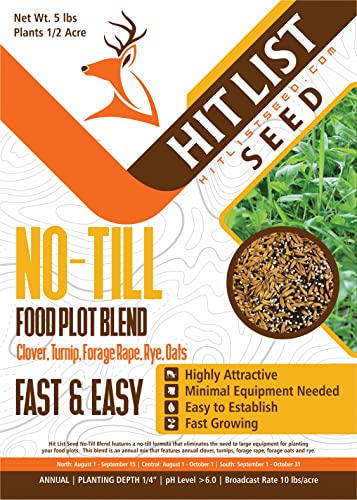
This no-till mix features crimson clover, purple top turnips, forage brassica, oats, and rye, creating an attractive and nutritious forage blend. It germinates quickly and is suitable for beginners, requiring minimal equipment. The variety supports deer attraction from early fall through late firearms season, making it a versatile choice for ongoing plot success.
- Quick germination with minimal equipment
- Crimson clover, turnips, brassica, oats, and rye
- Season-spanning appeal for hunting windows
- Designed for no-till planting in diverse sites
Whitetail Institute Imperial No-Plow Food Plot Seed

This Imperial blend is designed for areas hard to access with farming equipment. It includes cereal grains, annual clovers, brassica, radish, and lettuce, enabling productive plots in remote locations. You can plant on a prepared seedbed or with minimal ground preparation to establish solid seed-to-soil contact, delivering reliable deer forage despite limited cultivation options.
- Attractive annual forage for tough-to-reach sites
- Mixed cereal grains, clovers, brassica, radish, and lettuce
- Flexible planting approaches for remote areas
- Supports consistent deer traffic through season
Shady Patch No Till Deer Food Plot Seed

Shady Patch provides a no-till seed mix well-suited to shaded spots with limited sunlight. The blend includes white clover, brassica, rye grass, and rape seeds to establish an irresistible, year-round deer feeder. Its emphasis on shade tolerance makes it a practical choice for hunting grounds where light is sporadic but deer still need steady forage.
- No-till seed mix for shaded, low-light areas
- White clover, brassica, rye grass, and rape seeds
- All-season forage potential in limited sun
- Simple setup suitable for hunting spots
Buying Guide
Key purchase considerations
- Seasonality: Choose blends designed to cover early, mid, and late seasons for sustained deer traffic.
- Site accessibility: For remote or hard-to-reach areas, prioritize no-till and no-plow mixes that require minimal equipment.
- Soil and climate adaptability: Look for blends described as adaptable to different regions and soil types to maximize germination and growth.
- Protein and mineral content: Higher protein and mineral levels support deer health and antler development, especially in protein-scarce periods.
- Shade tolerance: If your plot location has limited sunlight, select blends formulated for shady sites to ensure reliable establishment.
Product comparisons
- Fast-establishing options: Look for mixes marketed as throw-and-grow or no-till with quick germination to see faster initial forage.
- Season-long attractants: Favor blends that balance early-season greens with late-season roots and brassicas for a continuous draw.
- Versatility: Choose multi-region or adaptive blends if your hunting property spans different climates or soil conditions.
- Ease of use: Beginner-friendly blends provide clear planting guidance and require minimal equipment for success.
When selecting a throw-and-grow food plot seed, balance ease of use with the expected nutritional output. Cross-reference the blend’s plant variety to ensure a mix that will attract deer across multiple seasons and adapt to your local terrain. Consider combining two complementary blends to extend the season and create a more resilient food plot.