Choosing the right plant growth regulator (PGR) can help manage fruit set, improve branching, and reduce maintenance for trees and ornamentals. This article reviews five reliable products designed for home gardens and professional landscapes, highlighting how each works, where to use them, and what to look for when buying. Read on to compare formulations, application scopes, and potential benefits across common tree species and ornamental varieties.
Summary of chosen products:
- Monterey Florel Plant Growth Regulator 1 Pint
- Monterey Florel Plant Growth Regulator 1 Quart
- Monterey Florel Brand Growth Regulator Residential 32oz
- Quali-Pro T-Nex Plant Growth Regulator (Primo Maxx) 128oz
- Atticus Pramaxis MEC Plant Growth Regulator (8 oz)
Monterey Florel Plant Growth Regulator 1 Pint

Monterey Florel 1 Pint is a versatile foliar regulator designed to prevent nuisance fruit formation on a range of fruiting and ornamental trees. It also supports branch development by encouraging lateral growth, which can improve canopy structure in trees and shrubs. The product label lists trees such as crabapple, flowering pear, maple, olive, and more, making it suitable for mixed landscapes where fruit control and aesthetic branching are both desired. When applied as directed, it can help balance growth and reduce maintenance tasks tied to fruit load and excessive shoot growth.
Monterey Florel Plant Growth Regulator 1 Quart

This quart-sized Florel product expands on the pint with a larger volume suitable for bigger trees or greater treatment areas. It shares the same fruit suppression and mistletoe shoot removal benefits, as well as promoting branching control to achieve a denser, healthier canopy. For landscapes with multiple ornamental trees or fruit-bearing specimens, the 1-quart package can cover more trees per application window without increasing the number of treatments.
Monterey Florel Brand Growth Regulator Residential 32oz

Monterey Florel Residential 32oz is tailored for home garden use, offering practical dosing for typical backyard trees and ornamentals. It focuses on reducing unwanted fruit formation and supporting growth management within a domestic setting, where easy handling and clear labeling are key. This option suits homeowners seeking a straightforward, ready-to-use solution for seasonal growth control without professional-grade scale.
Quali-Pro T-Nex Plant Growth Regulator (Primo Maxx) 128oz
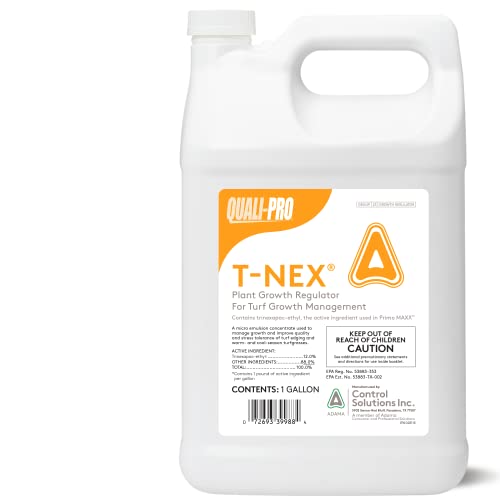
Quali-Pro T-Nex (Primo Maxx) 128oz focuses on growth management for turf and certain landscape grasses, offering a robust solution to improve color, stem and root development, and stress tolerance. While primarily associated with turf, its growth-regulating action can influence adjacent ornamentals by moderating vertical growth and encouraging a stronger, more resilient root system. It is well-suited for larger landscaped areas, golf courses, and athletic fields where consistent growth control is needed.
Atticus Pramaxis MEC Plant Growth Regulator (8 oz)

Atticus Pramaxis MEC Plant Growth Regulator contains trinexapac-ethyl, a widely trusted active ingredient for turf and landscape management. The product is designed to slow vertical growth, promote root development, and reduce mowing frequency. It is compatible with cool- and warm-season grasses and can help landscape managers balance aesthetics with maintenance across lawns, athletic fields, and mature tree surrounds where precise growth control is advantageous.
Buying Guide: Growth Regulator Options For Trees And Ornamentals
Key purchase considerations help ensure you select a product that matches your landscape goals and application needs. Consider the following perspectives:
- Scope of use: Some products emphasize fruit suppression on specific tree species, while others target overall canopy structure, branching, or turf-related growth. Match the product to your primary objective (fruit control, branching, or turf-adjacent management).
- Volume and application: Residential sizes (like 32 oz) are convenient for small yards, whereas quart and 128 oz containers suit larger landscapes or professional use. Calculate area coverage and label directions to avoid over- or under-application.
- Active ingredients: trinexapac-ethyl-based products (e.g., Pramaxis MEC and Primo Maxx variants) are widely used for turf and ornamental growth control. If you need more tree-specific fruit regulation, check the label for the list of approved species and usage notes.
- Safety and handling: Always follow label instructions regarding PPE, application timing, and drought or heat conditions. Some products are best applied during active growth periods, while others are tuned for specific seasonal windows.
- Impact on maintenance: Growth regulators often reduce mowing or pruning intensity but may alter regrowth patterns. Evaluate how slower vertical growth affects routine care, such as pruning schedules and canopy management.
- Environmental considerations: Consider runoff potential and proximity to water sources, and ensure compatibility with nearby ornamentals and grasses to prevent unintended effects on non-target plants.
- Budget and logistics: Larger containers may reduce per-unit cost but require more storage and handling. Balance upfront cost with long-term maintenance savings and labor reductions.
In selecting a growth regulator for trees, it is important to align the product’s label with your tree species, climate, and maintenance goals. For home gardens, residential formulas offer straightforward use and predictable results, while larger terrains may benefit from higher-volume products designed for broader coverage. For turf-adjacent goals, products like T-Nex provide a strong option to manage growth while supporting root mass and stress resilience. Always consult the label for compatible species, timing, and recommended application rates to achieve consistent results across your landscape.