Hatching a large number of eggs requires an incubator that can maintain stable temperature and humidity, automate turning, and provide clear visibility into embryo development. Below are five capable options that cater to higher‑capacity needs while offering reliable performance, ease of use, and informative monitoring features. The selections include models designed for 56 to 132 eggs, giving you robust choices for scaling up hatchery projects, classrooms, or farm operations.
style=”display:none;”>Summary Table of Selected Products
| Product | Capacity (Eggs) | Key Features |
|---|---|---|
| VIOPUMPO 48-132 Eggs Incubator | 48–132 | Automatic egg turning, humidity control, LED display, 60/90/120/150/180 minute turning intervals |
| Chalixion 120 Egg Incubator | Up to 120 | 5 incubation modes, automatic day counter, external water refill |
| Sailnovo 56 Egg Incubator | 56 | Automatic turning, auto humidification, 360° viewing, auto alarm |
| innhom 56 Eggs Incubator | 56 | Auto turning, precise humidity control, smart alarm system |
| ABTOR 25 Egg Incubator | 25 | LED display, digital temperature control, candler |
Sailnovo 56 Egg Incubator With Auto Turning

The Sailnovo incubator supports up to 56 eggs, offering automatic turning and auto humidification for consistent hatch conditions. Its 360° viewing feature provides clear observation from any angle, while an integrated alarm system helps monitor deviations in temperature or humidity. The unit includes a dedicated LED indicator and adjustable egg trays to accommodate mixed species and egg sizes, making it suitable for farm, classroom, or home hatchery applications. Its compact footprint helps save space without sacrificing performance.
innhom 56 Eggs Incubator With Humidity Control
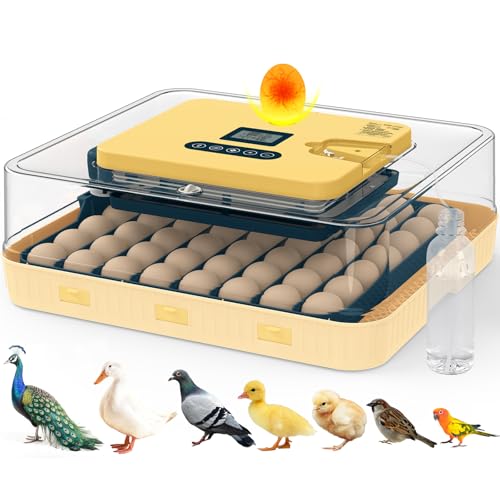
innhom’s 56-egg model emphasizes precise control of temperature and humidity, with an auto horizontal egg-turning system that mirrors natural incubation. The incubator includes eight dividers to handle different egg types at once, and a smart alarm that triggers if the temperature or humidity drifts outside the preset range. Its design focuses on minimizing manual intervention while boosting hatch rates, making it a practical option for mixed poultry operations and educational settings.
Chalixion 120 Egg Incubator With Five Modes

The Chalixion incubator targets higher capacity with up to 120 eggs and five automatic incubation modes. It includes an incubation day counter and an external water refill feature that minimizes heat loss when maintaining humidity. The unit is designed for reliable, long-term usage in larger hatchery operations or educational environments, with a focus on automated consistency and ease of monitoring throughout the incubation process.
VIOPUMPO 48-132 Eggs Incubator
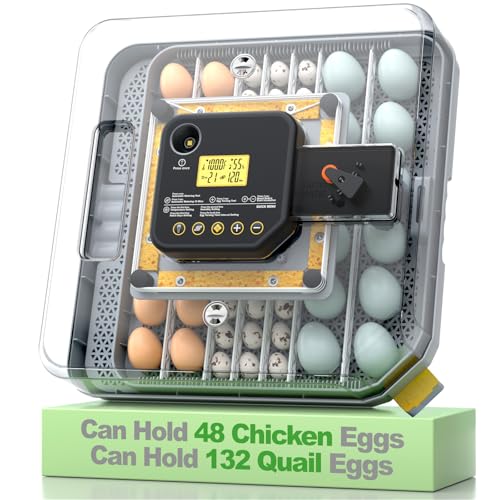
The VIOPUMPO model is designed for larger egg lots, supporting from 48 up to 132 eggs. It features automatic egg turning and intelligent humidity control, with an LED display for real-time monitoring. The adjustable tray configurations allow for a variety of poultry types, including chicken, duck, goose, and quail. External water refill helps maintain humidity without opening the lid, reducing temperature fluctuations and protecting hatch rates during the cycle.
Harris Farms Nurture Right Egg Incubator

Harris Farms offers a 360° viewing incubator with an automatic turnover mechanism and precise temperature and humidity controls. While its capacity is designed around 12–22 eggs, its 360° airflow and visibility features make it an attractive choice for smaller-scale components of a larger hatchery operation, enabling careful monitoring and reliable hatch outcomes across multiple batches. The design emphasizes uniform heat distribution and thorough egg observation throughout incubation.
ABTOR 25 Egg Incubator With Digital Controls

ABTOR’s 25-egg model uses a digital control panel to maintain consistent temperature and humidity, paired with a high-definition egg candler for embryo observation. While smaller in capacity, it complements higher-capacity units by offering a compact, user-friendly option for early-stage experiments, classrooms, or backup incubation in a mixed-operation environment. The LED display aids in precise monitoring and adjustments during incubation.
Buying Guide: Key Purchase Considerations
- Capacity and scalability: For a target around 100 eggs, opt for models that handle up to at least 100–132 eggs, and check if the unit can be expanded with additional racks or trays.
- Temperature stability: Look for reliable airflow systems and fans that deliver uniform heat distribution across all eggs, minimizing hotspots and cold zones.
- Humidity control: Humidity management is crucial for hatch rates. External water refilling and automatic humidification reduce lid opening and heat loss.
- Egg turning: Automatic turning mimics natural incubation and reduces manual handling. Confirm turning frequency and when it stops before hatching.
- Monitoring features: LED displays, alarms, and 360° visibility help track progress and quickly address deviations in temperature or humidity.
- Species versatility: If hatching multiple species (chickens, ducks, quail, turkeys), verify tray configurations and the acceptability of various egg sizes.
- Durability and warranty: Consider build quality, ease of cleaning, and manufacturer warranty for ongoing reliability in a farm or classroom setting.
- Ease of refilling water: External refilling prevents heat loss. Check how often refills are needed for typical incubation cycles.
- Maintenance and ease of use: Intuitive controls, clear indicators, and straightforward maintenance routines help reduce downtime and errors.
These selections provide options across capacity tiers, enabling large-egg operations to choose a solution that aligns with their hatch rates, species mix, and workflow. When evaluating models, consider not only raw capacity but also the reliability of turning mechanisms, humidity management, and monitoring visibility to maximize hatch success over multiple cycles.