Advances in soil sensing let farmers and home gardeners optimize irrigation, nutrient management, and crop health. This guide highlights five reliable soil sensors that suit American farming and gardening contexts, focusing on wireless capability, accuracy, durability, and ease of integration with gateways or apps. Each product section includes a quick overview and key features to help you compare options at a glance.
The following summary table lists the selected products and their core advantages to aid quick scanning.
| Product | Brand | Key Strengths | Connectivity |
|---|---|---|---|
| ECOWITT WH51 Soil Moisture Sensor | ECOWITT | Reliable moisture data, gateway integration | Wi‑Fi via GW1000/GW1100 (gateway sold separately) |
| ECOWITT WH51L Soil Moisture Sensor | ECOWITT | LCD display, deeper soil measurement | Gateway options; 8-channel support |
| ECOWITT GW1206 Soil Moisture Tester Kit | ECOWITT | All-in-one gateway + sensor kit | GW1200 IoT Wi‑Fi gateway |
| TreasureCave USB 7-in-1 Soil Sensor | TreasureCave | 7‑in‑1 rapid soil testing | USB connection to Android devices |
| Stemedu 5Pcs Capacitive Soil Moisture Sensor Module | Stemedu | Corrosion‑resistant capacitive sensing | Analog outputs for microcontrollers |
ECOWITT WH51 Soil Moisture Sensor

The ECOWITT WH51 is designed to measure soil moisture and transmit data through compatible gateways. It features a responsive sensor that reports moisture data within about 72 seconds once fully inserted into soil. When paired with a GW1000 or GW1100 Wi‑Fi gateway (sold separately), real-time data can be viewed via WS View Plus or the Ecowitt app after setup. This sensor supports multiple gateway configurations and channel editing for easy management of several sensors in a single system. In addition, it can upload data to the Ecowitt weather server to graph histories, set alerts, and monitor remotely via a web or mobile interface.
Key considerations include gateway compatibility, the need for a separate gateway for cloud access, and the ability to monitor multiple sensors across a farm or garden. The WH51 excels in reliability and expandability for integrated weather and soil data ecosystems.
ECOWITT WH51L Soil Moisture Sensor

The WH51L offers all the features of the WH51 with the addition of an LCD display for real-time moisture values. It comes with a 1m/3.28ft PVC wire probe that enables deeper soil measurement (up to nearly 80 cm). The IP66/IP68-rated waterproofing makes it suitable for outdoor use in diverse conditions. When connected to an Ecowitt gateway (GW1100, GW2000, GW1200, etc.), up to eight WH51L sensors can be controlled, and data can be viewed in the Ecowitt app. The ability to edit channel names on the app provides flexible organization for farms with multiple plots and sensors.
Considerations include IP rating, depth of measurement, and gateway requirements for cloud access and visualization. The WH51L is particularly strong for deeper soil profiling and on-site display alongside cloud-enabled dashboards.
ECOWITT GW1206 Soil Moisture Tester Kit

The GW1206 kit represents a complete indoor-outdoor solution, combining the GW1200 IoT Wi-Fi gateway with WH51 soil moisture sensors. The gateway supports both indoor weather station functions and soil sensor data streaming to the Ecowitt app, providing a cohesive view of climate and soil conditions. The gateway supports firmware updates and configurable data retention, making it suitable for ongoing farm operations. The kit’s bundled approach reduces setup complexity for users seeking a turnkey monitoring system with cloud access and historical data.
Considerations include gateway features, data visualization options, and future expansion with additional WH51/WH51L sensors. This kit is ideal for growers who want a ready-to-run, scalable soil moisture monitoring system integrated with weather data.
TreasureCave USB 7-in-1 Digital Soil Tester
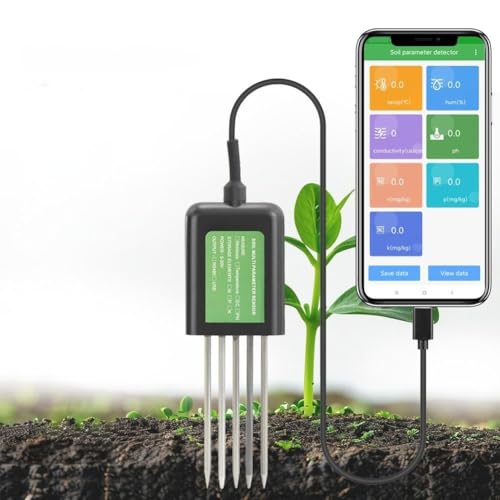
This 7‑in‑1 USB soil tester provides comprehensive soil analysis, including moisture, conductivity, temperature, pH, and essential NPK nutrients. It connects to Android devices via USB, enabling real-time data viewing, saving, and exporting through a mobile app. The device is designed for quick field checks and ongoing soil health assessments, with a waterproof design rated IP68 and a rust‑proof metal probe for durability in moist soils. It suits researchers or field technicians who need portable, multi-parameter soil data on the go.
When evaluating this device, consider the need for a mobile app ecosystem, data export options, and the extent to which 7-in-1 data meets your soil management decisions. It is particularly useful for rapid, on-site testing and cross-referencing with more continuous monitoring sensors.
Stemedu 5Pcs Capacitive Soil Moisture Sensor Module

The Stemedu capacitive sensors use a non-contact capacitive principle to measure soil moisture, reducing corrosion risk and extending sensor life compared with resistive types. The set is designed for 3.3–5.5 V operation with an analog signal output, compatible with typical microcontroller projects for Arduino or Raspberry Pi with an ADC. This option is suitable for hobbyists and researchers building custom irrigation or nutrient management systems, particularly where sensor longevity and low maintenance are priorities.
Key considerations include the need for an ADC, integration with existing microcontroller platforms, and the suitability of capacitive sensing in your soil type and irrigation regime. The package provides an economical way to deploy multiple sensors for spatial soil moisture mapping.
Buying Guide: How to Choose The Right Soil Sensor For Your Farm Or Garden
- Measurement depth and soil type: Some sensors measure shallow moisture, while others (like WH51L) extend depth. Choose based on root zones and soil composition (sandy, loamy, clay).
- Connectivity and gateway ecosystem: Decide if you prefer cloud-enabled dashboards via a gateway (GW1000/GW1200/GW1100) or local monitoring. Consider whether you need real-time alerts and historical graphs.
- Sensor durability and environmental sealing: For outdoor fields, IP ratings (IP66/IP68) and waterproofing influence long-term performance in rain, irrigation, and mineral-rich soils.
- Display and visualization: LCD displays and mobile apps vary in usability. An LCD on WH51L aids on-site checks; app dashboards assist in remote monitoring and trends analysis.
- Power and installation: Wireless sensors with batteries or USB-powered gateways affect maintenance cycles. Install depth, cable length, and placement to avoid interference from metal structures or dense roots.
- Multi-sensor scalability: If monitoring multiple plots, ensure the gateway supports multiple channels and easy channel naming. A scalable setup reduces management complexity across fields.
- Additional soil parameters: Some kits offer 7-in-1 measurements (moisture, EC, pH, temperature, NPK). Define which metrics drive your irrigation and fertilization plans.
- Data access and export: Cloud-based servers offer graphs and history. For compliance or long-term research, confirm data export formats and retention settings.
- Budget and total cost of ownership: initial kit price, gateway requirements, number of sensors, and potential subscription costs for cloud services should be weighed against forecasted gains in yield and resource savings.
Across these products, the choice often centers on whether you prioritize turnkey cloud-enabled monitoring (WH51, WH51L, GW1206) or a flexible, modular approach (capacitive sensors like Stemedu, Songhe, or 7‑in‑1 USB testers). For producers seeking scalable, farm-wide insights, a gateway-connected system with the ability to add multiple sensor channels tends to deliver the most value over time. For small plots or experimental setups, battery-free or USB-based testers can provide quick diagnostics and initial data without infrastructure investment.